




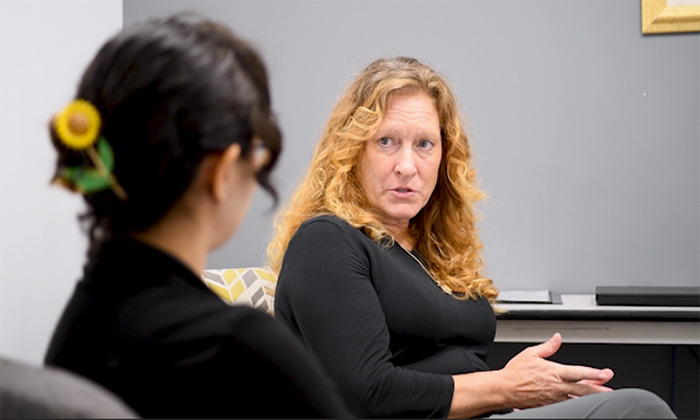
In this episode of “Faculty in Focus,” we spotlight Dr. Lisa Jackson-Cherry, Director of the School of Counseling within the College of Health and Education. She highlights the newly opened CMHC Training Clinic, the importance of mental health resources and her hopes that her work will positively impact the DMV area for years to come.
How did you first get interested in counseling?
I did not start my career in counseling—I took a longer journey through criminal justice settings. Early in my professional development, I worked in a women’s correctional facility and then with a law enforcement agency helping at-risk youth. These experiences led me to pursue my graduate degree in criminal justice at the University of South Carolina. While there, my advisor introduced me to counseling and explained how it could be a good fit for my future career goals. I then worked at several South Carolina high schools, including an alternative residential high school where I developed the conflict resolution program and served as conflict resolution counselor.
Before getting into higher education, I moved to Maryland and continued working as a school system behavioral specialist and then as a director of Baltimore City’s mobile crisis team. I was hired as an adjunct to teach a crisis intervention course at Loyola University of Maryland in its pastoral counseling program. As a licensed clinical professional counselor in Maryland at the time, I joined a psychologist to start a private practice. Until 2021, my practice was with a primary care physician on Maryland’s Eastern Shore, working mainly with medically underserved populations.
What drew you to Marymount?
I knew about Marymount University as I attended Catholic schools most of my life, and even looked at it for an undergraduate program. However, my high school counselor and teacher encouraged me to attend the University of Notre Dame of Maryland. Being a first-generation college student in my family, I followed their recommendation. As an adjunct professor at Loyola, I started looking at full-time teaching positions and one at Marymount became available in 2000.
How do Marymount’s Counseling courses stand out from other universities?
Our School of Counseling faculty are either currently involved or have been involved in professional clinical practices, consultative services and leadership positions in the profession. They offer diverse clinical experiences that extend to their classroom teachings, preparing our students to work with clients across diverse populations, clinical diagnoses and the developmental lifespan. Our $1.2 million HRSA grant allows us to offer stipends to current students to work with medically underserved populations, and provided us the opportunity to re-explore our long-time goal of developing a community clinic. We have over 25 years of presence in the DMV community with many clinical partnerships. Our program has incredibly unique electives, including equine-assisted psychotherapy, human sexuality and neuropsychological treatment classes.
What inspired the clinic’s creation?
The inspiration for the CMHC Training Clinic began a decade ago, and it had to move through its own journey and timeframe to become a reality. The mission of a community clinic serving the community fits well with the mission of Marymount University, the College of Health and Education and the School of Counseling. Although mental health disparity and accessibility has always been a barrier for many in seeking mental health services, the impact of COVID-19 and the focus on mental health worldwide led to a greater understanding of the need for mental wellness. The ability to offer free mental health counseling services to those who may not be able to pay, who may not seek out counseling due to a stigma or who may have been underserved allows us to meet a need in our own community while also training master’s level clinical mental health counselors and doctoral level supervisors.
What do you hope the clinic will accomplish?
The CMHC Training Clinic’s mission is to offer free mental health services to anyone in the community through our in-person clinic or telehealth services, with a focus on those who may not have access to mental health services or who may be from an underserved community. Services provided by our master’s and doctoral level students, under faculty supervision, will serve as a strong clinical training opportunity that generates research in the mental health field. We also hope to offer unique supportive mental health services to those who serve others in high-stress professions, such as health care workers, caregivers, teachers, military service members, first responders and their families.

Do you have any advice you want to pass on to students?
First, view everyone as a unique person. Everyone you meet, professionally or personally, has their own story with their own personal challenges. Do not assume, based only on what you can see, that you understand their story.
Second, do not underestimate your impact. Assisting clients in working through their pain is a privilege. You may never know the impact you have on one person, but it may extend for generations. Because you may not know your impact, you may often question if you are making a positive impact.
Third, be well. To help others, you must also be well and take care of your own challenges. A professional counselor can only be effective if they are healthy and well. A professional counselor is not immune to life circumstances, so do not neglect your own physical, mental and spiritual wellness.
Fourth, be grateful. Most of us did not get where we are now on our own. Sometimes our paths were filled with challenges and obstacles. All of our life circumstances, and persons involved, provided opportunities and led you to the path you are on right now.
