




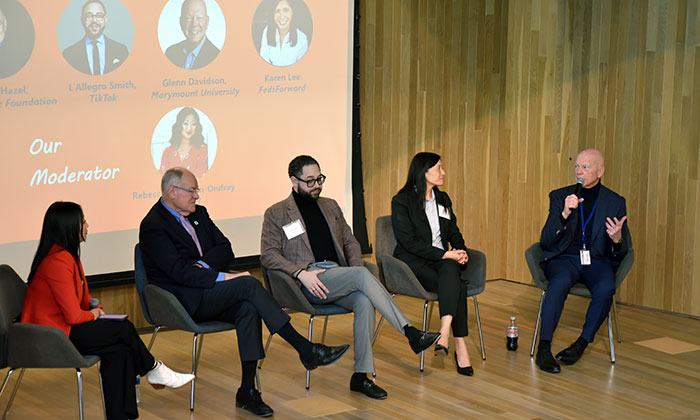
About 230 participants gathered at Marymount University’s Ballston Center on April 8 for Career Forward, a one-day, hands-on summit designed to help displaced federal workers and government contractors navigate career transitions and explore new opportunities across sectors.
Hosted in partnership with Virginia Works, the sold-out event brought regional leaders, industry experts and career coaches together to provide practical tools and personalized guidance at a time of significant workforce disruption. Marymount President Irma Becerra and Virginia Secretary of Labor Jessica Looman opened the day with welcoming remarks, emphasizing the University and the Commonwealth’s commitment to supporting this specialized workforce.
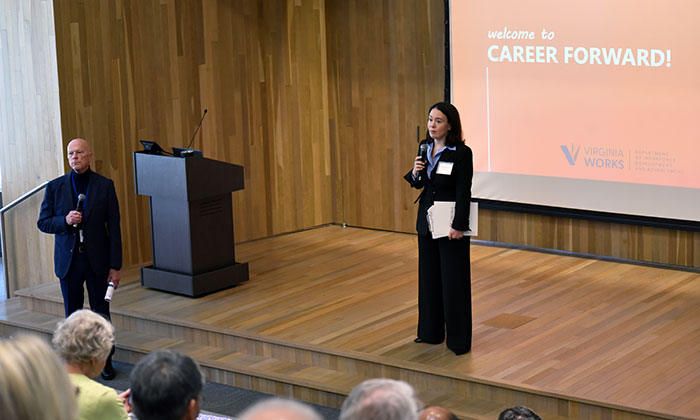
“We believe in the power of lifelong learning here at Marymount, and today reflects that belief,” President Becerra said. “Whether you are exploring a new role in the public sector, considering opportunities in private industry or even thinking about launching something of your own, you are not starting from scratch. You are building on a foundation of experience, education and expertise that is incredibly valuable. Our role is to help you translate that experience into what comes next.”
“I want you to remember, most importantly, that no one in this room did anything wrong,” added Virginia Secretary of Labor Jessica Looman. “Especially during a career transition, it’s easy to lose sight of that. But this is not your fault, and you showed up today. The skills you’ve built in federal service—navigating complex systems, managing large-scale programs, working across agencies and serving the public—are exactly what employers are looking for.”
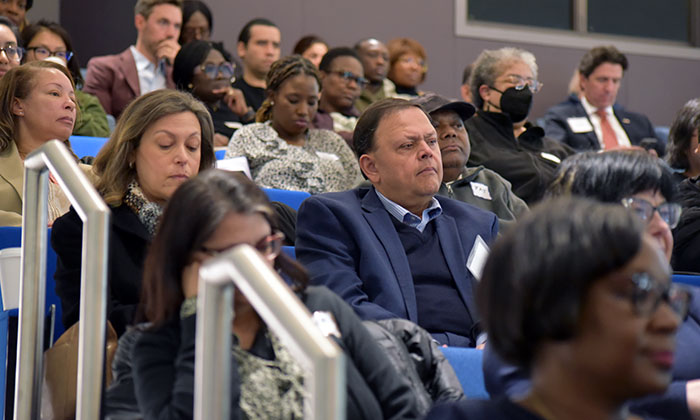
Arlington County Board Chair Matt de Ferranti joined President Becerra and Secretary Looman to share the regional impact of federal workforce shifts, while also offering perspective on what comes next. According to figures reported in January by the Virginia Department of Workforce Development and Advancement, the number of unemployed Arlington residents spiked 51 percent from November 2024 to November 2025.
“Arlington is a community shaped by public service, by people committed to something larger than themselves,” de Ferranti explained. “Our unemployment rate has increased significantly over the past year, and that’s something we don’t want to sugarcoat. But this summit isn’t a reset button—it’s not about starting from nothing. It’s a bridge between one chapter and the next.”
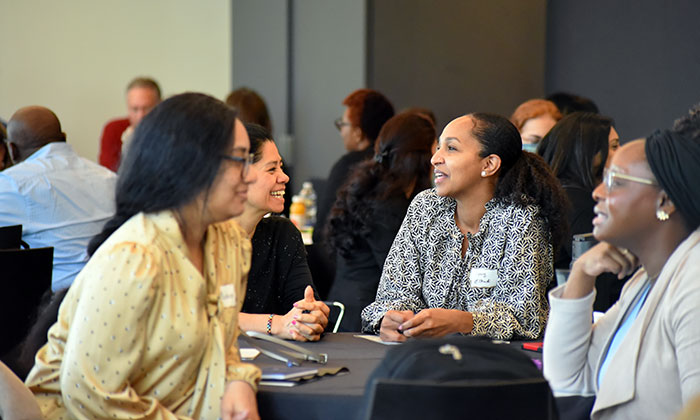
Throughout the day, participants selected from tailored breakout sessions focused on translating federal skills, navigating new hiring systems, launching businesses and building personal brands. A hands-on workshop highlighted how artificial intelligence can support job searches, while afternoon sessions addressed financial planning and career pivot strategies.
“At this moment, it’s really about identifying and discovering your transferable skills, thinking about how to pivot to an entirely new industry and exploring what that might look like for you,” said Nicole Overley, Commissioner of Virginia Works. “It’s also about connecting with industry leaders and making sure you’re building the skills you need to be successful. There are a lot of people in the job market right now looking to make big moves, and we’re working closely with employers to understand what they’re looking for so we can help every candidate prepare.”
Marymount faculty and industry leaders led sector-based discussions during lunchtime “salons,” covering fields such as cybersecurity, health care, education, consulting and artificial intelligence. For many facilitators, the opportunity to work directly with participants was especially meaningful.
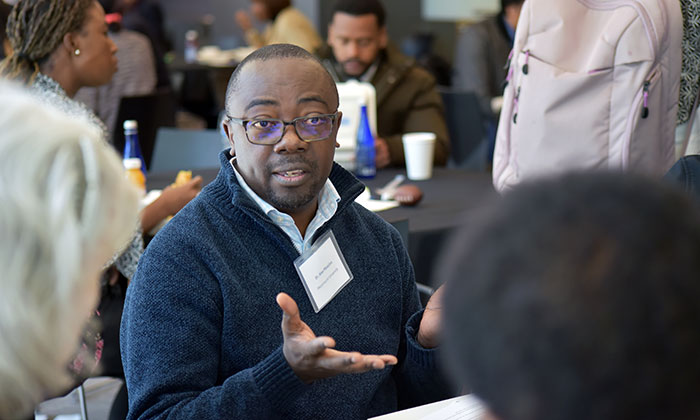
“It was a privilege to work with displaced federal workers and government contractors, helping them translate their extensive experience into new opportunities in the private sector and local government,” said Dr. Alex Mbaziira, Associate Professor of Cyber and AI at Marymount.
“I was struck by the willingness of participants to speak candidly about both loss and aspiration,” added Dr. Jessica Marotta, Director of Marymount’s School of Education. “Many described the disorientation of having long-held professional identities disrupted, yet within those same conversations emerged a remarkable sense of hope. Individuals openly shared their vulnerabilities while simultaneously articulating new dreams, which demonstrated both resilience and a readiness to reimagine their future pathways.”
For many attendees and partners, Career Forward addressed a growing need for coordinated support systems amid widespread workforce changes. Karen Esser, a former deputy director of civil rights at the U.S. Department of Labor, retired from the government in 2025 following 24 years of service. She recalled leaving a role that was “the highlight of my career, the job I had always wanted,” earlier than she would have liked because of significant disruptions to federal agency operations. She is now a senior advisor at FedsForward, a nonprofit supporting federal employees in their transition.
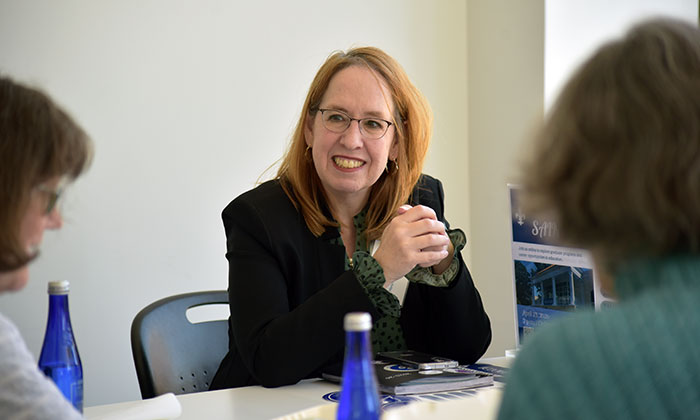
“In January 2025, I started to see signs that we were about to see a volume of federal employees entering career transitions all at once that we hadn’t seen before,” Esser said. “I felt strongly that they were going to need support in ways they hadn’t previously, and that those resources didn’t fully exist. Given my background as a federal employee and as an employment lawyer, I wanted to be part of a solution—helping people navigate their options and understand their rights as they moved into new roles.”
Participants, whose time without a job has varied from as little as a few weeks to over a year, described the challenges they have faced and the mindset needed to move forward.
“While this has been a setback, it’s also been an opportunity for growth and has strengthened my resilience,” said Anthony, a former government contractor. “I’m continuing to work on improving my communication skills and confidence, and I believe that wherever I land next, I’ll be better because of what I’ve gone through.”
“What stands out about an event like this is the chance to meet people in person,” added Martha Horn, a former government contractor who specialized in FEMA-related projects. “The job search process has become pretty impersonal, so having the opportunity to connect directly with people at an organization and get a sense of what it’s actually like to work there is really valuable.”
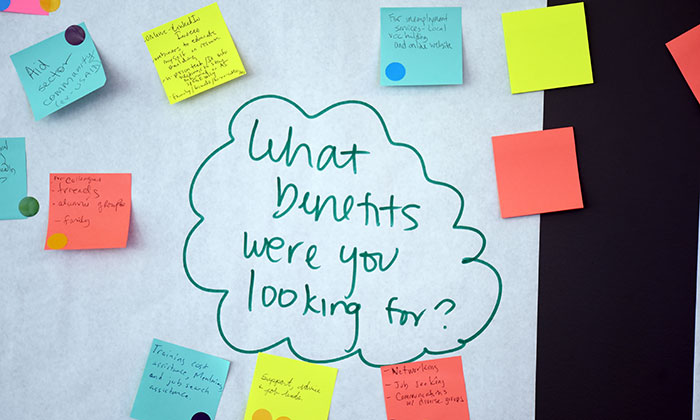
The summit concluded with an Action Planning Lab, where attendees developed personalized 30, 60 and 90-day roadmaps with guidance from career coaches and Marymount faculty. For organizers, the day represented both a response to immediate needs and a longer-term commitment to supporting the region’s workforce.
“Today was an emotional day for many of the people in attendance,” said Glenn Davidson, Marymount’s Chief Strategy Officer and Executive Director of the Center for Career Development & Community Engagement. “For some, it was a chance to process frustration, hurt and uncertainty, and was a cathartic moment. At the same time, there was a tremendous amount of gratitude from participants for bringing people together, for sharing real stories of career pivoting, for offering practical strategies and, most importantly, for giving them a sense of hope and encouragement as they navigate what comes next.”
