





Two students in Marymount University’s Interior Architecture and Design master’s program, Zhuyun “Joy” Xu and Mallory Myers-Payne, have been recognized in Metropolis Magazine’s Future100. The annual list recognizes the nation’s top architecture and interior design students, with Xu and Myers-Payne among just 17 designers named in the graduate interior design category.
The Future100 list has now featured nine Marymount undergraduate and graduate students since its inception in 2021. Others include Nicolas Swaner ‘21, Viviane Pedruco ‘22, Natalia Laykov ‘23, a trio of students in 2024 and Maia Hoonan ‘25.

Joy Xu, Class of 2026
Beginning her career as a data scientist, Xu pivoted to interior design and joined Marymount’s program in 2023. Since then, she has garnered recognition—participating in inclusive design research, placing in the Top 28 of the 2025 NEXT Steelcase Student Design competition and winning the graduate category of the 2025 Interior Design Educators Council (IDEC) Student Competition alongside fellow Marymount student Gabriella Sulzer.
Xu says her data science background allows her to see design through an “analytical lens that grounds creativity in evidence.” Her portfolio emphasizes experiential, intergenerational and neuroinclusive design, often incorporating interactive elements that invite users to engage directly with a space.
“For example, I created a rotating café so users can experience different views throughout the day. In others, I’ve included movable elements or sensory features like interactive walls. Those moments of interaction create a personal connection between the user and the space. I want people to feel like they can engage with a design, not just exist within it.”

Highlights from Xu’s portfolio include her IDEC award-winning design for a multi-use space called “Symphony Grove,” which seeks to bring generations together through music. Another notable project is a neuroinclusive office space design that netted her the Top 28 spot in the 2025 Steelcase competition.
Assistant Professor Salvatore Pirrone, who nominated Xu, praised her range and creativity.
“Joy’s technical ability and willingness to take risks make her a delight to work with. Her work is thoughtful, empathic and visually complex. Whether she is looking at the overall layout or a handrail detail, Joy is leading the way in her field.”

Mallory Myers-Payne, Class of 2026
With a background in studio art and biology, Myers-Payne found her path in Marymount’s Interior Architecture and Design program, where she has built a portfolio grounded in research, creativity and collaboration.
Associate Professor Moira Denson, her nominator, described Myers-Payne’s work as “thoughtful and human-centered.”
“Whether she is exploring materiality, developing thoughtful narratives or working on timely intergenerational research, Mallory consistently demonstrates the ability to zoom out to understand the system and zoom in to craft human-centered spatial details.”
Myers-Payne’s projects span health care, hospitality and experiential design, often exploring intergenerational connections and the impact of built environments on behavior and well-being.
“We spend about 90 percent of our lives indoors, so the quality of those environments really matters,” she explained. “I want to create spaces that improve people’s lives and allow them to engage with their environment in meaningful ways.”
This focus is evident in her design for an Intergenerational Wellness and Innovation Center, which uses interactive features—such as a found object library and interactive media ribbon—to spark curiosity and storytelling across age groups.
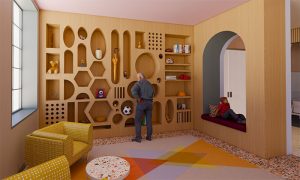
Myers-Payne called the Metropolis recognition “surprising and validating,” made even more meaningful by sharing the honor with Xu.
“Joy is one of my closest friends, and she has had a huge impact on my creative journey,” she said. “Being recognized together makes the experience even more special. It feels like a shared accomplishment.”
Jessica Bonness, Director of Marymount’s Interior Architecture and Design program, expressed pride in Xu and Myers-Payne’s work and their futures as designers.
“We are very proud of Mallory and Joy and are glad that Metropolis has recognized their talent and drive,” Bonness said. “They join a large class of Marymount Interior Architecture and Design Metropolis Future100 scholars, and we are excited to see what they achieve when they move on into the workforce.”
