




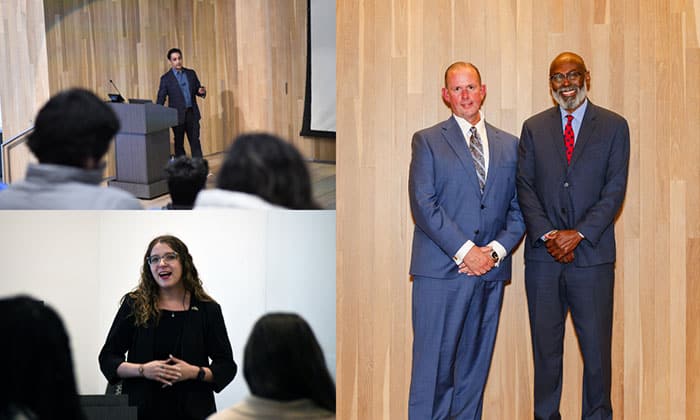
During the 2025-26 academic year, Marymount alumni from across industries returned to campus to share their personal and professional experiences with students as part of the inaugural Alumni Speaker Series. Over the course of three lectures, alumni explored topics including ethical healthcare leadership, civic responsibility and the future of technology in the AI age.
The Climb to Leadership: Navigating Adversity on the Path to Success (College of Health and Education)
For the first installment of the Alumni Lecture Series, the College of Health and Education welcomed health care leaders and former flight nurses Ben Hughes ’04 ’06 and Allen Wolfe ’08 back to campus for a discussion titled “The Climb to Leadership: Navigating Adversity on the Path to Success.”
Both alumni shared how their experiences providing critical care as flight nurses at MedStar Washington Hospital Center shaped their leadership journeys and taught them to remain calm under pressure while caring for patients during emergencies like the COVID-19 pandemic and the 9/11 attack on the Pentagon.

Hughes, now the nursing operations director for University of Kentucky Health Care’s trauma and acute care surgery service, reflected on overcoming rejection early in his academic journey.
“I applied to a nurse anesthesia program at a local university, but they told me that with my grades, I wouldn’t make it through the program,” Hughes recalled. “I hung up that call and immediately applied to Marymount’s nursing program instead. I ended up graduating with not one but two master’s degrees…That initial ‘no’ was the key to leading me into a rewarding career of impact and purpose.”
Wolfe, who went on to serve as chief flight nurse before becoming senior director of education at Life Link III, spoke about facing racism and prejudice throughout his career and emphasized the importance of compassionate care.
“First and foremost, you need to learn how to effectively care for patients,” Wolfe said. “I don’t care how many diplomas or trophies you have on your wall. You can get all the education in the world, but if you don’t have the skills or the passion for helping patients, you can’t be an effective health care leader.”
Both alumni stressed the importance of mentorship and giving back to the next generation of health care professionals.
“I became a leader so I could give back and mentor young people with a true passion for health care,” Hughes said. “I got my passion from my mentors, and I want to help instill that passion in others.”
Emerging Technologies: AI, Quantum, and the Future of Innovation (College of Business, Innovation, Leadership and Technology)
In March 2026, the College of Business, Innovation, Leadership and Technology (BILT) welcomed tech entrepreneur Suresh Nair ’09 to discuss the future of AI and innovation in an ever-changing field.
Nair, president and CEO of Ina Solutions Inc., shared his personal journey from working full-time in technology while attending Marymount as a part-time graduate student to leading a company focused on digital transformation, AI and quantum computing.
The lecture centered on the growing role of AI and quantum computing in the future workforce. Nair explained that while artificial intelligence is already embedded in everyday life, quantum computing represents the next frontier of technological advancement.
“Quantum computing is the next generation of AI. Think of it in terms of a maze. When asked to solve the maze, traditional AI works in a very sequential, step-by-step manner to get to the end. In contrast, quantum will not only solve the maze but will give you every possible solution at the same time. Quantum is what will give us breakthroughs in fields such as drug discovery, cybersecurity and advanced materials research.”
Nair emphasized that students do not need to become experts in quantum physics or advanced coding to participate in the future technology workforce.
“We’re not trying to create quantum physicists for the workforce,” he said. “We are trying to create people who can handle quantum sensors, workflows and applications. This technology is for everyone, but you’ve got to be curious.”
Nair closed his lecture by encouraging students to pursue careers rooted not only in innovation, but also in purpose.
“The desire to make an impact — that was always my main motive,” Nair said. “Make sure that whatever you are doing, you’re doing it to add value to the world, to make a positive impact.”
Staying Human Under Pressure: Leadership in Public Service (College of Sciences and Humanities)
To close out the Spring semester, Marymount’s College of Sciences and Humanities hosted a lecture by alumna Jacki Garry ’17 titled, “Staying Human Under Pressure: Leadership in Public Service.”
A criminal justice and sociology graduate, Garry serves as the Chief of Staff to Delegate Karrie Delaney in the Virginia House of Delegates, where she has helped pass legislation related to healthcare affordability, education and trafficking and sexual assault survivor support.
Garry shared insights on the importance of approaching disagreements from a “balanced, human” perspective to create truly bipartisan solutions.
“Part of staying human in a divisive environment is taking time to recognize the humanity of other people,” Garry explained. “It’s easy for those who disagree with you to become your opponent or your enemy. It is much more effective to reframe the narrative, to remind yourself that those on the other side of the aisle are also human beings with their own perspectives, goals and constituencies they aim to represent.”
Garry emphasized how this human-first approach allowed her and Delegate Delaney to create impactful Safe Harbor legislation to protect minors involved in sex trafficking from being sent to prison or detention centers, even after their first iteration of the bill was shot down.
“Rather than assume the ill intent of those who disagreed with us, we decided to try and look at the issue from their perspective,” Garry explained. “We had uncomfortable conversations and did the work to create something truly bipartisan that took both sides of the issue into account.”
After working with opposition lawmakers to adjust language, the bill passed unanimously in the General Assembly and will take effect in July of 2026.
“One of the biggest lessons I’ve learned is that the democratic process requires that we become comfortable with discomfort, that we should actively seek out difficult conversations and confront them head on because that is when we make real progress and create real change.”
