





To kick off Marymount University’s 75th Anniversary Homecoming Weekend, the College of Health and Education hosted the institution’s inaugural Alumni Speaker Series event, featuring health care leaders Ben Hughes ’04 ’06 and Allen Wolfe ’08.
The pair presented “The Climb to Leadership: Navigating Adversity on the Path to Success,” sharing powerful stories of resilience and perseverance in their personal and professional lives.
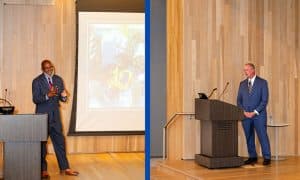
For Hughes, adversity came from his personal circumstances. Born and raised in rural Kentucky, he was one of the only members of his family to graduate from college and the first to earn a doctorate. After failing to be accepted into multiple nursing schools, he finally obtained a degree from the Catholic University of America before setting his sights on becoming a nurse anesthetist.
“I applied to an anesthesia program at a local university—they told me that with my grades, I wouldn’t make it through the program. They said it wasn’t worth trying. I hung up the phone and applied to Marymount’s program, and ended up graduating with not one but two master’s degrees. That ‘no’ was the key to leading me into a rewarding career of impact and purpose.”
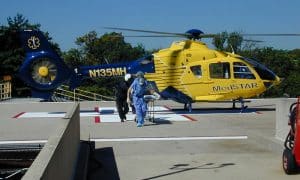
After graduating from Marymount with degrees in Critical Care Nursing and Health Care Management, Hughes spent time as a flight nurse with the MedSTAR helicopter transport team at MedStar Washington Hospital Center, providing care to critical patients en route to the hospital.
“In that role, I learned that you’ve got to be ready for whatever the job throws at you,” Hughes said. “Every day you’re facing something different, and you need the mental agility to overcome any situation.”
This approach became essential for Hughes as he faced mass casualty incidents, the September 11 attack on the Pentagon, the onset of the COVID-19 pandemic and two family members battling cancer. He is currently serving as the nursing operations director for University of Kentucky Health Care’s trauma and acute care surgery service.
“Don’t let adversity stop you, keep pushing past it,” Hughes told the audience. “Life is going to be difficult. Don’t get overwhelmed by all of the challenges—focus on the process of overcoming them, and you will rise above.”
Wolfe then shared his personal experiences with overcoming adversity, including battling prejudice and racism at every step of his educational journey as he grew up as a Black man in Alabama.
“Early on, I had patients who refused to allow me to care for them purely because of my skin color. I also had people tell me I didn’t belong in nursing as a man. I thought of my mother in those moments. She worked her entire career as a nurse, teaching me how to lead and serve. Even when she faced racist comments and prejudice from patients and coworkers, she modeled professionalism. She encouraged me to keep pushing and keep moving forward, no matter what I faced.”
After graduating from George Mason University, Wolfe joined the flight program at Washington Hospital Center that focused on trauma care for critical patients. There, he spent 10 years as the chief flight nurse, channeling his passion into improving patient care.
“First and foremost, you need to learn how to effectively care for patients. I don’t care how many diplomas or trophies you have on your wall. You can get all the education in the world, but if you don’t have the skills or the passion for helping patients, you can’t be an effective health care leader.”
Wolfe met Hughes during his time as a flight clinician and was then introduced to Marymount’s graduate programs.
“The idea of going back to school was intimidating. I had tons of experience, but applying it in a classroom was a different ballgame. But I decided to embrace it. My time at Marymount was really enriching, and the degree I got catapulted me into the next phase of my career.”
After graduating with his master’s in Critical Care, Wolfe modeled effective health care leadership as he published several articles and textbooks while also developing a prehospital color-coding system for LVAD transport devices that became widely adopted in the medical field. He now serves as the senior director of education at Life Link III, where he leads a team of over 100 flight clinicians at 12 air medical bases in Minnesota and Wisconsin.
Hughes and Wolfe say their main focus now is paying it forward and educating the next generation.
“I became a leader so I could give back and mentor young people with a true passion for health care,” Hughes said. “It’s such an honor to be back here at Marymount, speaking to the next generation of health care leaders. I got my passion from my mentors, and I want to help instill that passion in others.”
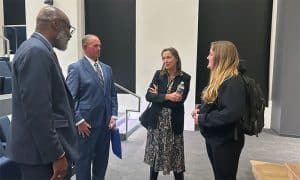
Alumna Catherine Johnson ’21, an event attendee, says the presentation gave her valuable insights into challenges in the nursing profession.
“I’m interested in flight nursing, so hearing how they overcame adversity throughout their careers was incredibly inspiring.”
Dr. Skye Donovan, Dean of the College of Health and Education, emphasized how Hughes and Wolfe are demonstrating Marymount’s ideals.
“Hearing the professional journey of our two alumni was truly moving. Each of them has impacted not only thousands of patients but generations of nursing students and professionals across the country, a true example of Saints who serve.”
The College of BILT will host the second installment of the Alumni Speaker Series in March.
