



Summer Programs
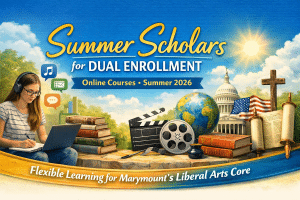
Summer Scholars for Dual Enrollment.
Summer 2026 Dual Enrollment offers a focused set of online, asynchronous courses—meaning students don’t have a required live class meeting at a specific time. Instead students log in to the course site and complete work on their own sechedule within set weekly (or module) deadlines. Students may be required to watch recorded lectures, do readings, particpate in discussion boards, and submit assignments by due dates. Communication with the instruction mainly through messages, announcemnets, and psoted feedback. The key is a more flexible style of learning, but you need strong time management to succeed.
This summer’s limited online lineup are course that supports Marymount’s Liberal Arts Core pathways.
MA 132 — Statistical Analysis An introduction to basic descriptive and inferential statistical procedures used in the analysis of data. Prerequisites: complete the university’s directed self-placement process or a grade of C or better in MA 094 or MA 095; placement into or completion of EN 101. Liberal Arts Core: Mathematics (MT). Credits: 3.
MUS 123 — Great Composers Explores in depth the life and music of well-known musical composers, using a particular composer as a focal point of study. Reviews how personal life and historical events shaped musical style, and how social, political, and religious influences are reflected in the music. Includes listening to and analyzing major works; introduces musical forms and elements such as melody, harmony, rhythm, and pitch. Liberal Arts Core: Fine and Performing Arts (FPA). Credits: 3.
POL 103 — Comparative Politics An introduction to the workings of politics inside countries other than the United States and an examination of the main conceptual approaches to understanding authority, institutions, and political change. Liberal Arts Core: Social Science (SS). Credits: 3.
TRS 100 — Theological Inquiry Introduces the discipline of Christian theology as a foundation for further study in theology and religious studies. Examines perennial questions of existence and Christian responses; surveys the development of Christian theology and the role theology can play in students’ lives, culture, and the world. Addresses responsibilities of Christianity in a pluralistic world; includes significant reading and writing. Prerequisite: EN 101 or higher. Liberal Arts Core: Theology and Religious Studies (TRS). Credits: 3.
TRS 251 — The Religion of the Old Testament Designed as an introduction to the tools, resources, and critical methods for reading and interpreting Old Testament scripture, with attention to the historical context from which the Judeo-Christian faith and its confessional documents emerged. Prerequisite: TRS 100. Liberal Arts Core: Depth in Faith and Reason (DF&R;). Credits: 3.
HI 110 — History of the United States to 1877 A survey of United States history from the colonial period to 1877, emphasizing colonial origins, the struggle for independence, and the continuing struggle to implement and preserve democratic principles and governmental structure. Examines major economic, cultural, and social changes. Liberal Arts Core: History (HI). Credits: 3.
EN 182 — The Movie or the Book? Narrative Adaptation in the Cinema Studies narrative strategies in film, including adaptations from print to film and film genres. Examines films from a literary perspective and introduces vocabulary of film studies through theoretical lenses such as feminism, genre studies, and multiculturalism. Focuses on how medium affects storytelling and how visual narratives differ from, or derive from, textual narratives. Prerequisite: EN 102 with minimum grade of C- or instructor permission. Also listed as IS 182. Liberal Arts Core: Literature (LT). Credits: 3.
PSY 101 — General Psychology Introduces the content and scope of psychology as a behavioral science, exploring topics such as development, language, memory, social influence, personality, and psychological disorders. Examines biological, social, and cultural influences on behavior and mental processes; applies psychological principles to everyday life. Liberal Arts Core: Social Science (SS). Credits: 3.
Seats are limited. To be considered, students must email to request an application and receive next-step instructions.
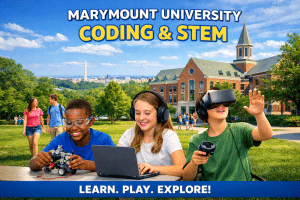
Coding Camps & STEM Programs at Marymount University for ages 7-17
On Campus at Marymount University
Get a taste of collegiate life this summer at Marymount University! Our Arlington camps strike the perfect balance between STEM skill development and summer fun, allowing kids and teens to experience a week at a nationally-recognized university. Your child will work alongside new friends and learn from expert tech mentors – in coding, game dev, robotics, 3D printing, and more – while taking breaks in between to enjoy Marymount’s outdoor playing fields for ultimate frisbee, capture the flag, kickball, board games, and other activities!
In addition to skill-building and friendships, each iD Tech camp offers students the valuable opportunity of exploring a prestigious university campus. At Marymount University, this includes chowing down alongside future tech disruptors, taking in campus landmarks like the Ballston Coakley Library, and basking in the sunshine during outdoor activities and games across Ballston Wetland Park. The entire experience gives students an exciting glimpse into their own bright future.
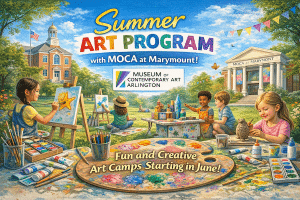
Summer Art Program offered by MOCA at Marymount.
We collaborate with the Museum of Contemporary Art Arlington, which organizes and staffs the camps. MOCA Arlington typically offers bi-weekly camps starting in June and running through August. They usually post their schedule by January or February, and you can register your daughter from their website here. You can currently sign up for their email list to receive notifications when they do.