




Research Spotlight: Inclusive Design for Aging Communities
Lead Faculty Researcher:
Student Researcher:
Joy Xu
Project Title:
Using Building Information Modeling (BIM) and Virtual Reality to Research Optimal Interior Materials for Our Aging Community
What were the goals of this research project?
Moira Denson: My research focuses on the sensory changes experienced by older adults. In 2023, after attending HUD’s Innovative Housing Showcase in Washington, D.C. as an observer, I noticed that many of the “innovative” housing features on display were not addressing the sensory needs of aging populations. This observation sparked the idea to take action.
I developed a survey tool and launched a project around this gap, initially bringing on a student researcher to help assess the homes on display. What started as a small pilot quickly revealed broader implications: the designs being promoted as forward-looking were often overlooking accessibility for older adults.
The following year, we advanced our involvement by exhibiting at the Showcase ourselves. This time, instead of only observing, we directly engaged more than 5,000 members of the public, inviting them to use our survey to evaluate the homes. The public’s participation not only validated our concerns but also inspired us to consider how our findings could be shared more widely.
At that point, we brought Joy into the project. Her earlier class research aligned with our focus, and her contributions strengthened the study. What began with one student researcher has now grown into a collaboration that bridges academia, the public, and industry professionals. Today, we are preparing to publish a peer-reviewed article based on two years of data—transforming initial observations into scholarship that addresses an urgent need in housing design.
Joy, how were you involved as a student researcher?
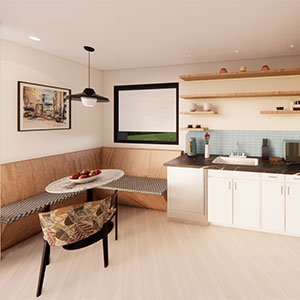
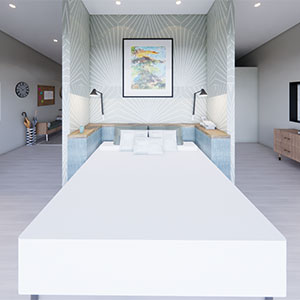
Joy Xu: My role in the project focused on the vision-related aspects of interior design for aging populations. I worked on creating renderings that show the kinds of changes that should be made, like using high contrast in the bathroom between the floor and the countertop or toilet seat. People with cataracts can’t distinguish those features well when everything blends together. I integrated AI into the project by asking ChatGPT to help generate images based on what someone with cataracts might see. That helped me understand how contrast and clarity are crucial. If a bathroom floor is too dark, for example, it can look like a hole, which makes older adults afraid to step onto it. I used these findings to adjust renderings for a bathroom, entryway and bedroom to make them safer and more livable spaces for someone with visual impairments.
What do you plan to do with your research?
Moira Denson: We’re currently submitting the first part of the project to a peer-reviewed journal, likely one focused on rehabilitation or health professions. That’s a bit outside the usual interior architecture space, so it’s a unique crossover. The article is considered an educational piece, and it’s being reviewed by Marymount’s Center for Optimal Aging.
The second part of the work may be turned into a public-facing guide that’s accessible and usable by designers and caregivers to help them create more inclusive spaces for aging populations. Our idea is to make this topic more digestible to the everyday person. Rather than forcing these individuals to comb through research papers and technical jargon to find out more about housing adjustments, the guide will be easy to understand and apply in a practical sense. The whole point of publishing our work is to make it accessible. Joy’s visuals are especially helpful as they take the research and translate it into something actionable and compelling.
How did this project help you become a better researcher and designer?
Joy Xu: This experience helped me build empathy and think more deeply about a specific population—in this case, older adults. In most design studios, we might do user journey maps or talk about users in general, but the scope is big and we don’t usually dive into detailed accessibility needs.
This project taught me to think at a more granular level—how specific materials, colors and textures impact someone with visual impairments. I learned how to design for real needs. It also gave me a unique chance to experience academic writing and publishing, which is rare in interior design. That contrast between academic and industry work was eye-opening, and I feel more prepared to bridge those two worlds moving forward.
Moira Denson: We’re so proud of Joy. She brought not only technical skill but also curiosity and persistence. That’s exactly what this kind of research needs. We’re lucky to have students like her who want to learn and make an impact. Anytime someone highlights student work in interior design, it showcases just how much expertise and passion our students bring.
