




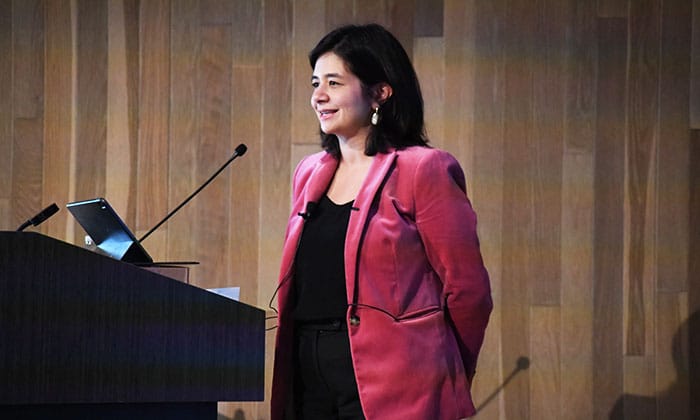
The Marymount University community gathered at the Ballston Center on April 16 for the third annual Dana Keegan & Martha Child Lecture Series event, hosted by the Interior Architecture and Design (IAD) program. Established in 2023 as a gift from the Keegan family, the series provides a platform for design students to learn directly from practitioners shaping the industry’s future.
“The Keegan Lecture is a hallmark of the IAD program, and we were incredibly proud to bring acclaimed designer Ming Thompson to campus to share her insights on design and community building,” said Jessica Bonness, Director of Marymount’s IAD program. “It’s experiences like these that uplift and inspire our students, and we are so grateful to the Keegan family for making it possible.”
Thompson, founding principal of Atelier Cho Thompson and a critic at the Yale School of Architecture, delivered a lecture as this year’s featured speaker on “Care and Collective Space: Interior Design for Hospitality and Community.” She was introduced by the two recipients of the 2026 Keegan Scholarship, senior Alessia Barrios and graduate student Terran Quattlebaum.
“Ming Thompson is focused on bettering human experience through design. She insists that good design must occur at all scales, from the building to the furniture to the logo, and everything in between,” Quattlebaum said. “It is truly a privilege to welcome a designer whose work so powerfully explores care, community and the way spaces shape human connection.”

“I consistently tell my students that design is a service profession,” Thompson said during her lecture. “We serve our clients and our users by balancing and understanding their needs and desires alongside our professional expertise. Interior design is, at its best, an act of care.”
Throughout her talk, Thompson challenged common misconceptions about the field, emphasizing that interior design is not simply “decorative” but fundamental to how people live and interact.
“Someone told me once that they thought interior design was the icing on top of a design project, but I don’t think that’s right at all,” she explained. “Interior design is not just picking chairs out of a catalog or colors for a room. It is a tool through which we can improve the human experience. Interior design is not the icing, it’s actually the cake itself.”
Thompson continued to support her claim that “interiors matter” by citing new scientific findings from researchers Ivy Ross and Susan Magsamen about the impact of design on the human psyche. Their book, “Your Brain on Art,” argues that engaging in “aesthetic experiences” reduces stress hormones and reinforces positive emotions.
“Scientists and researchers are finally coming around to treating design with the seriousness it deserves,” Thompson said. “Interior design has a great impact on health, and our brains in particular. Our brains are wired to respond to beautiful, safe, welcoming spaces. Hospitality, or the practice of intentionally creating these conditions for others, is not merely a social nicety. It’s an act that engages our deepest neurobiological systems.”

Thompson then shared snapshots from her company’s portfolio, highlighting the profound impact interior design can have on behavior. One project was her company’s low-budget redesign of 100 school cafeterias in the San Francisco Unified School District over the course of 10 years, using new furniture and culturally relevant murals and graphics to transform each cafeteria into a “fun, welcoming place” to learn and grow.
“In the words of one school administrator, ‘We still have the same four walls, but the students are enjoying and respecting the space like never before. The redesign has also been effective in disrupting class and racial segregation and has led to fewer conflicts between student groups.’ That is the power of design.”
The presentation concluded with student attendees asking questions about design, business and Thompson’s career, as the featured speaker spoke about what keeps her motivated and what future designers should focus on most.
“Everything we design should educate people. If we bring more good design to people, they will start to understand why design matters,” she explained. “Designing your life is going to be the greatest project you’ll ever undertake. Write down all the things that matter most to you and chart a future that centers around those things.”
