




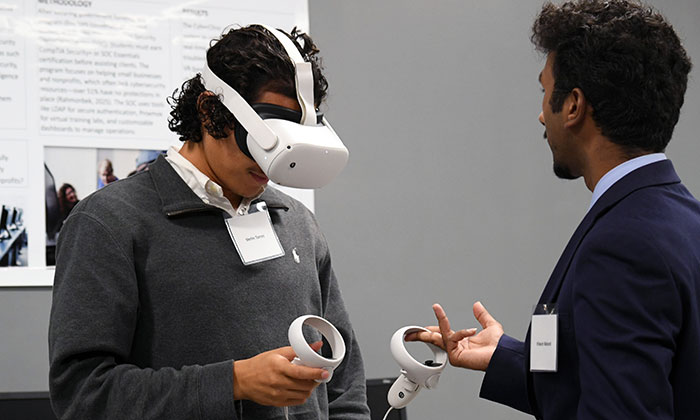
Students, faculty and cybersecurity professionals gathered at Marymount University’s Ballston Center last week for the inaugural Cyber Saints WiCyS Conference, hosted by the Marymount University student chapter of Women in Cybersecurity (WiCyS).
With the theme of “Navigating AI’s Shift in Cybersecurity,” the event connected learners with industry experts through a series of skill-building technical workshops, research presentations, a capture-the-flag competition developed by certified Cybersecurity students from Marymount’s CyberClinic team and extensive networking opportunities. Designed and organized by students, the conference helped attendees explore emerging trends and pathways to success in the rapidly evolving cybersecurity field.
“Attending events like this can be very beneficial in helping students come out of their shell and network with peers and professionals with the same goals and interests,” said Maha Noor, senior Information Technology major and president of the Cyber Saints WiCyS Club. “We wanted to bring cybersecurity professionals to campus to help our students develop the skills needed to thrive in the field and navigate the emergence of new AI technologies.”
Nearly 100 students attended, including students from George Mason University, Georgetown University, Northern Virginia Community College, University of Maryland Global Campus and Washington University of Science and Technology.
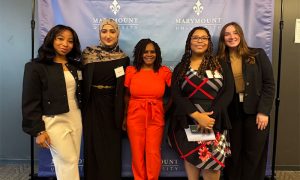
The event opened with a keynote from Nikkia Henderson, President of the Women in Cybersecurity Mid-Atlantic Affiliate (WiCyS MAA), who encouraged attendees to embrace authenticity and confidence as they grow into future leaders.
“Don’t play the comparison game or get stuck in imposter syndrome. Remember that you are the asset—you have the experience, knowledge and expertise to create real impact.”
Workshops throughout the day emphasized both technical and professional development. Dr. Fatou Sankare ’23, Marymount alumna and adjunct professor, led a session on “The Psychology of Intrusion: How Hackers Think and Exploit.” It encouraged students to explore AI tools critically and lead future conversations around cybersecurity policy.
“Don’t be afraid to use AI programs—explore what they can do and learn to tell a good one from a bad one. That way, you can lead the charge when it comes to AI policy and application in many industries.”
Dr. Jonathan Luckett ’24, a management and program analyst with the U.S. Secret Service, presented on his academic journey and AI research. He described how Marymount’s Doctorate in Cybersecurity prepared him to lead in the rapidly evolving AI field.
“AI is the most revolutionary technology of the modern age,” Dr. Luckett explained. “AI literacy is no longer optional. It’s absolutely fundamental. The Marymount program gave me the tools and guidance to understand how important AI research is. Now, I am helping to inspire the next generation of leaders to embrace and engage with AI.”
For senior IT major Ramy Rozario, the conference offered valuable insight into her future career.
“As someone who wants to work in cybersecurity, it was eye-opening to hear from experts about the challenges they’ve faced and the skills I should focus on as I enter the workforce.”
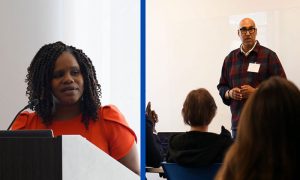
Assistant Cybersecurity professor and Cyber Saints WiCyS faculty advisor Dr. Susan Conrad praised the student leaders for their work to bring new opportunities to local students.
“Maha and the other student leaders did a phenomenal job at managing all the details of the conference and really making it their own,” she explained. “Events like these are so valuable because they inspire students to take charge of their learning journeys. By connecting with professionals in the field, they gain valuable insights into real-world practices and see how what they learn in the classroom comes alive in the workplace.”
The conference’s impact has already been felt in the local community as Georgetown students have reached out to Cyber Saints WiCyS for help in organizing their own conference. Noor says plans are underway for next year’s Cyber Saints WiCyS event, with hopes to expand its reach and strengthen regional connections.
“Our goal is to build a strong community of motivated students who support and learn from one another across the DMV,” Noor shared. “We’re so grateful to all the professionals who shared their time and expertise, and we’re excited to keep creating opportunities for students to grow and lead in cybersecurity.”
