




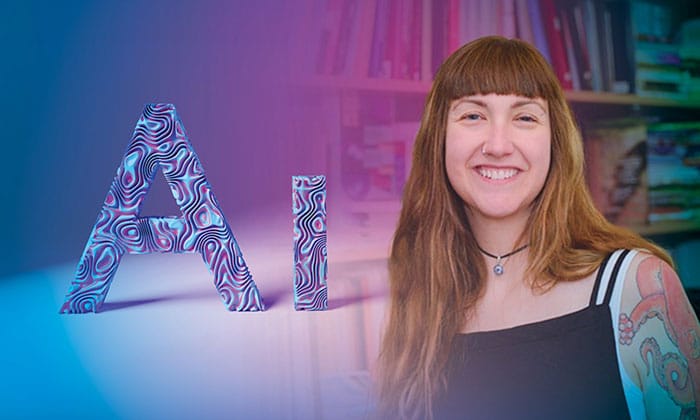
Marymount University welcomed students, faculty and community members to its Ballston Center on April 21 for the 2026 Bisson Lecture, an engaging and thought-provoking discussion on the evolving role of artificial intelligence in society.
Titled “Hell Is Other Robots: Understanding What AI Is (And Isn’t),” the lecture featured Dr. Robin Zebrowski, professor of cognitive science at Beloit College in Wisconsin. She guided attendees through the history, capabilities and ethical challenges of AI.
“I discussed some of the history of AI through three waves,” she explained following the event. “The first wave is ‘good old-fashioned AI,’ which is the high-level symbolic programming with pre-specified rules that dominated computing between the 1950s and 1990s. The second wave is artificial neural networks, where large language models live. And the third wave is 4E cognition – embodied, embedded, extended and enactive. This is where dynamic robotics comes in.”
While many contemporary discussions focus narrowly on generative AI, she emphasized that these tools represent just one part of a broader and more complex technological landscape.
Throughout the lecture, Dr. Zebrowski challenged the audience to think critically about the difference between well-designed algorithms that can complete tasks and machines that can go a step further and “think,” in a meaningful sense. Ignoring that distinction, she argued, has contributed to serious concerns surrounding current AI use, including issues related to misuse and human well-being.
“AI is a polarizing topic – there are AI cheerleaders and AI skeptics,” said Dr. Carl Sachs, Professor of Philosophy at Marymount University. “Dr. Zebrowski showed a reasonably moderate approach – cognitive tools in general are great, and some machine learning tools are amazing, but that doesn’t mean we should dismiss worries about the safety, reliability and sustainability of generative AI. One can be skeptical of Silicon Valley AI hype without being a Luddite!”
The lecture addressed a wide range of ethical challenges tied to generative AI. Dr. Zebrowski pointed to “15 dimensions of ethical harm,” including environmental concerns, political disinformation, large-scale plagiarism, surveillance practices and psychological harm.
“Generative AI is basically a nightmare from my perspective,” she stated. “I don’t think there are any benefits that outweigh the harms.”
Still, Dr. Zebrowski clarified that other forms of artificial intelligence, separate from generative AI, can offer meaningful contributions, particularly in research settings.
“I wouldn’t have been working in AI for so long if I didn’t think it was a worthwhile project,” she said. “There are great scientific uses of traditional machine learning algorithms and even old-fashioned AI systems that predate generative AI.”
Looking ahead, Dr. Zebrowski called for stronger societal responses to the rapid expansion of AI technologies, including increased regulation and broader public education.
“Honestly, I think most of these systems should be regulated nearly out of existence,” she said, describing the current moment as part of a broader cycle of AI hype. “I hope I gave folks lots to think about and reasons to reconsider casual use of the technology.”
