




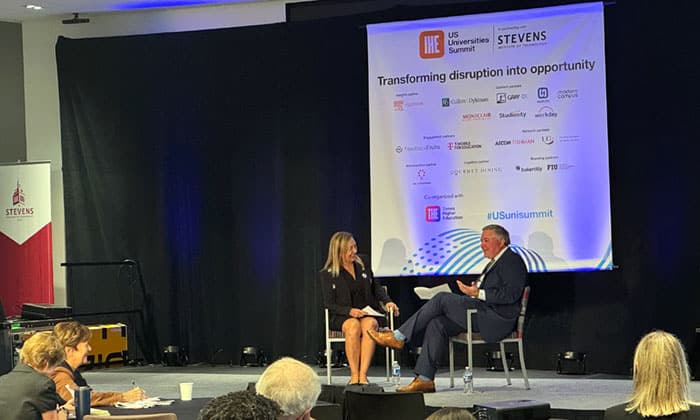
Marymount University President Irma Becerra joined higher education leaders from across the nation this week as a featured speaker at Inside Higher Ed’s 2025 U.S. Universities Summit, held in Hoboken, N.J. on October 13-14.
The invitation-only event convened more than 150 presidents, chancellors and provosts from over 75 colleges and universities to explore the evolving higher education landscape amid significant economic and technological change. Through in-depth and solution-oriented discussions, leaders examined the challenges and opportunities shaping their institutions in an era of rapid transformation.
President Becerra participated in a featured session on “Leading the Future of Work on Campus” alongside Mike Hofherr, group general manager of product industry at Workday. Their discussion focused on how human and AI collaboration is reshaping the nature of work in higher education, from administrative operations to academic innovation and student preparation for the workforce.
“Higher education is under tremendous financial pressure,” President Becerra said during the conversation. “Across the country, universities are facing significant headwinds—declining enrollment, rising costs and a changing funding landscape. Fortunately, Marymount has been an exception. We’ve seen record enrollment growth for two years in a row, but many institutions have not been as lucky. The reality is that the model of automatic annual tuition increases is no longer sustainable. Institutions must analyze their cost structures and rethink efficiency.”
In the face of this challenge, she explained how the University is committed to maintaining both high access and strong outcomes for students. The conversation also touched on the importance of diversifying revenue beyond tuition. One example of how Marymount is accomplishing that, she said, is through its Early Learning Academy. Launched in 2023, it provides high-quality early childhood education to the community while serving as a clinical site for students in the School of Education, who can work directly with children as part of their coursework. It is currently operating with a waiting list due to high demand.
Throughout the session, President Becerra reflected on how AI is transforming campus life, faculty engagement and the student learning experience. She applauded Marymount’s School of Technology and Innovation for launching Virginia’s first bachelor’s degree in Artificial Intelligence, while acknowledging concerns related to academic integrity and AI-assisted coursework.
A pioneer in the field herself, President Becerra shared her longstanding academic perspective on the technology.
“I’ve been studying AI for decades, and my research focuses on knowledge management—essentially, how organizations learn and share information,” she explained. “AI has the power to enhance human intelligence, not replace it. AI is to our cognitive ability what eyeglasses are to our eyes—it helps us see more clearly and understand more deeply. It allows experts to spend less time on repetitive work and more time on the creative and analytical work that truly moves institutions forward.”
President Becerra emphasized how Marymount’s approach to academic programs and career preparation aligns closely with the skills demanded by today’s and tomorrow’s workforce. She cited the University’s requirement for every student to complete an internship before graduation, and how the institution’s focus on experiential learning leads to students consistently outperforming their predicted starting salaries.
As one of only two universities in the nation selected as a Workday Education Partner, Marymount’s new Workday College initiative exemplifies that commitment to real-world readiness. The program allows students to earn globally recognized Workday certifications, giving them practical, industry-aligned skills that enhance their marketability.
Looking ahead, President Becerra called on university leaders to embrace agility and courage as higher education enters the AI era.
“The speed of AI adoption is unprecedented, and the question for higher education is, ‘can we keep up?’” she said. “Access to the tools alone isn’t enough. Faculty, staff and students all need structured opportunities to learn how to use AI thoughtfully and effectively. Leadership must model adaptability. The best way to lead through this change is to embody it ourselves—to stay open, to learn and to evolve alongside our institutions.”
