




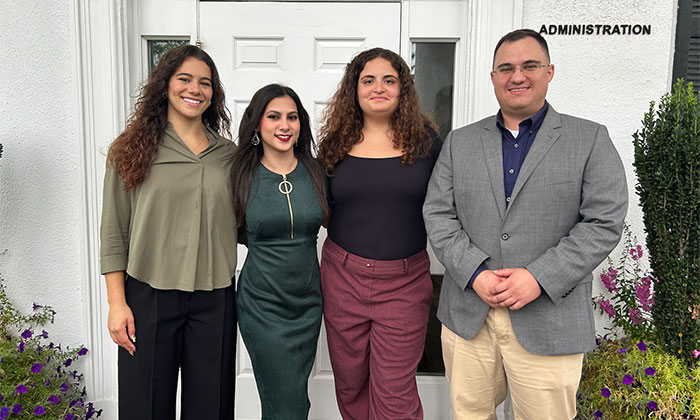
As Marymount University celebrates its 75th anniversary year, it also celebrates another impressive milestone—a new all-Hispanic executive board of the Student Government Association (SGA).
This year sees senior Sofia Jubraj elected by students to serve as SGA President, senior Adriana Rodriguez-Denner as Vice President, junior Isabella Rivera as Secretary and senior Richard Flores as Treasurer. It also marks a shift in student leadership demographics, reflecting the student body as a whole—approximately 43 percent of Marymount undergraduates identify as Hispanic.
“Having a fully Hispanic-identifying e-board is a big deal for us as a Hispanic-Serving Institution with a large Hispanic and Latino population,” Rodriguez-Denner said. “It is unfortunately common that Hispanic students don’t feel heard or appreciated in many higher education spaces. So it’s very special for us to represent those students and show them they really do have a voice at Marymount.”
United on the theme of “legacy” for the 2025-26 school year, the executive board is making plans to revamp elements of the student experience, including service opportunities and student engagement. One of the first major changes is the reintroduction of the SGA’s Community Service Committee to support a slate of new University-wide service projects they hope to bring to campus.
“We want students to feel more connected to each other, their professors and the wider community, and service is a great way to accomplish that,” Rivera said. “We are so lucky to have such a vibrant Hispanic community on campus and in the Arlington area, and we really want to tap into that through increased community engagement.”
Alongside new programming, they plan to overhaul the SGA’s financial policy to create a streamlined way to allocate more funds to campus clubs and increase the scale of club events. The aim is to drive an increase in student event attendance from approximately 20 students to 75-100.
“We’re really pushing to create bigger and better events that can engage more students,” Flores explained. “There is so much value in experiencing new things and getting connected to people outside of your major or interest area. Our goal is to give students those opportunities on a larger scale.”
Overall, Jubraj hopes these changes can create a positive legacy on campus and encourage more students to become involved in student government.
“We want our students to know what student government is and how we can serve them. We are willing and able to be their voice, bridging the gap between the administration, faculty and students. I hope that students can see the positive impact we are making on campus and know just how important student leadership and involvement can be to a University community.”
