




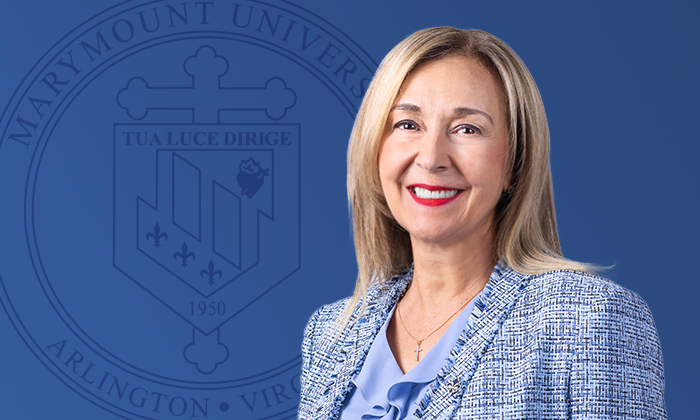
Marymount University President Irma Becerra has been appointed Chair of the Board of Trustees for the Consortium of Universities of the Washington Metropolitan Area for the 2025–2026 term.
The Consortium is a coalition of higher education institutions across the national capital region, serving more than 300,000 students and employing over 100,000 people. Together, its members contribute more than $15 billion annually to the region’s economy. The organization drives collaboration on shared priorities such as student success, workforce development, public-private partnerships and regional impact.
President Becerra succeeds Gallaudet University President Roberta “Bobbi” Cordano, who made history as the first Consortium board chair to serve two consecutive terms. President Becerra previously served as Vice Chair and Treasurer of the Consortium’s Board. This marks the third time that Marymount’s president has held this Consortium role, following the tenures of President James Bundschuh (2009–2011) and President Majella Berg (1992–1993) as Board Chair.
“I am truly honored to assume the role of Chair for the Consortium’s Board of Trustees,” President Becerra said. “Our region is home to some of the world’s most respected colleges and universities. Together, we have a unique opportunity to lead with vision, tackle complex challenges and strengthen opportunities for the students and communities we serve. I look forward to building on the Consortium’s strong foundation and working alongside my fellow presidents to advance our collective mission.”
Since arriving at Marymount in 2018, President Becerra has guided the University through transformative growth, from expanding academic programs and student services to achieving recognition as Virginia’s first Hispanic-Serving Institution. A Cuban-born American engineer and the first woman to earn a Ph.D. in electrical engineering from Florida International University, she has launched innovative programs and positioned Marymount as a leader in student opportunity and success.
Under her leadership, Marymount has earned its highest-ever national ranking in U.S. News & World Report and was one of only 33 universities nationwide recognized by Carnegie and the American Council on Education for both research excellence and student opportunity. The University was one of just three private not-for-profit institutions in Virginia classified as an Opportunity College & University with higher access and earnings, reflecting its commitment to first-generation, lower-income and underrepresented students while ensuring graduates achieve earnings well above regional medians.
Marymount has also been ranked among the top private institutions in Virginia for return on investment by Georgetown University’s Center on Education and the Workforce and was named to the 2026 Forbes Top Colleges list, underscoring its growing reputation for excellence, equity and strong student outcomes.
In addition to her role at Marymount, President Becerra serves on several influential boards, including the Council of Independent Colleges in Virginia, the Hispanic Association of Colleges and Universities, the Greater Washington Board of Trade, the Northern Virginia Technology Council, the Science Museum of Virginia and United Educators.
“At a pivotal moment for higher education, and understanding the tremendous pressure facing college presidents, I am so grateful that President Becerra agreed to take on leadership of our Consortium Board,” added Andrew Flagel, President and CEO of the Consortium of Universities of the Washington Metropolitan Area. “Her vision for regional partnership and commitment to educational opportunity comes at a time when we need the Consortium to have a transformative impact for our members and our community.”
The Consortium’s work in recent years has included initiatives to combat student hunger, reduce gun violence, expand workforce housing and publish comprehensive research on the economic impact of higher education in the Washington metropolitan area.
