




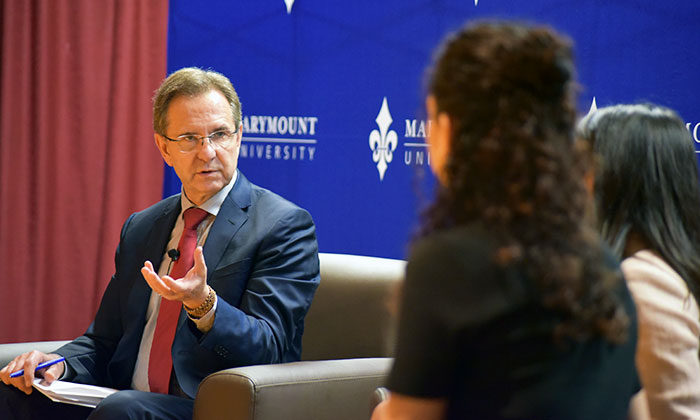
Mexican Ambassador Esteban Moctezuma Barragán delivered a speech on campus last week emphasizing the strategic importance of U.S.-Mexico relations and collaboration across North America, reinforcing Marymount University’s commitment to global perspectives.
Speaking before a diverse audience of Marymount students, faculty, staff and special guests, he praised the University’s potential and commented on how education plays a crucial role in international relations. The Ambassador’s remarks, centered on the “North American Advantage,” underscored the interconnected futures of the U.S., Mexico and Canada while stressing the need for cooperation to ensure competitiveness and security.
“The futures of the U.S. and Mexico are directly linked,” Ambassador Moctezuma said. “Our two countries and Canada must work together strategically to compete more effectively globally. This isn’t just about being friendly neighbors – it’s about leveraging our combined strengths to create mutual benefits that will make North America the most competitive, safe and humanistic region in the world.”
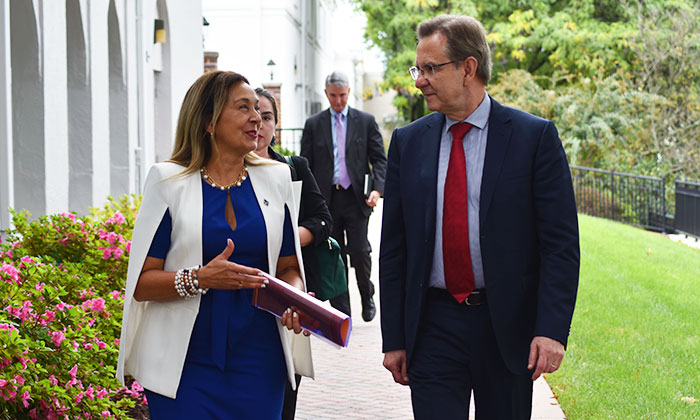
Marymount University President Irma Becerra welcomed the Mexican Ambassador and recognized the importance of the visit, particularly as Marymount celebrates its status as Virginia’s first and only Hispanic-Serving Institution (HSI) during Hispanic Heritage Month. Before the event, Marymount leadership met with the Ambassador and Mexican Embassy representatives to explore opportunities that include educational exchanges, student recruitment, faculty partnerships and Embassy internships.
“The Ambassador’s visit represents a significant occasion for our University as we continue to foster global connections and open doors to meaningful dialogue,” President Becerra said. “We take great pride in Marymount’s status as Virginia’s first and only Hispanic-Serving Institution, and we are one of the most diverse campuses in the entire country. Our students represent a broad spectrum of cultures, countries and perspectives.”
The Ambassador’s speech covered critical topics affecting the U.S. and Mexico, including migration, trade and education. He discussed how migration should be viewed as an opportunity to provide diverse talent and support economic growth in sectors such as agriculture and construction. He also touched on the need for comprehensive immigration reform, asserting that a regional approach is essential to address challenges like border security, the fentanyl trade and human trafficking.
Ambassador Moctezuma also described how cross-border education collaborations are necessary, calling education “the bridge that connects our nations, our cultures and our future.” He urged students to embrace the diversity around them and to think beyond borders.
“Your experience at Marymount is a microcosm of our interconnected world,” he added, encouraging students to seek out diverse perspectives and be the architects of future relationships between the U.S. and Mexico.
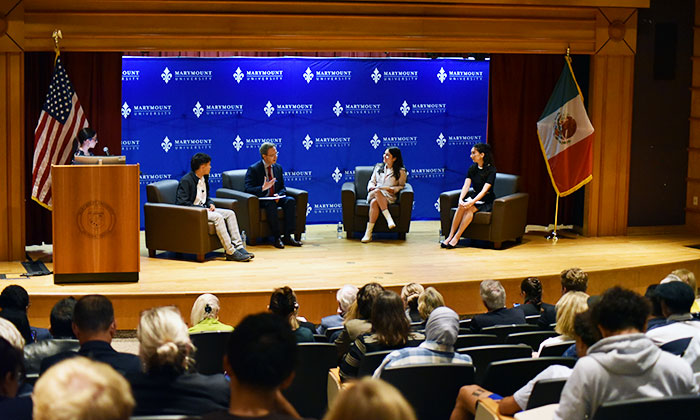
Following the Ambassador’s remarks, a student panel joined him for a dynamic discussion moderated by the Vice President of Marymount’s Student Government Association, Sofia Jubraj. Topics included the role of diplomacy in avoiding conflict, understanding cultural differences when working abroad and how embassies can reflect their home countries’ cultures through interior design.
“I have family members in Ecuador who work in diplomacy, so knowing their behind-the-scenes roles in this field helped better prepare me for this opportunity to serve as moderator,” said Jubraj, who is majoring in Political Science and International Relations at Marymount. “My particular area of study in international relations is the idea of political violence and radicalization, which transcends borders and we see it in the U.S., Mexico and all sorts of countries. Being able to research that topic and consult with different governments and even think tanks would be a dream for me and is my end goal, so this chance to meet and interact with global leaders was very relevant for me.”
Elene Japaridze, a junior at Marymount, is pursuing a career in diplomacy and described the panel as a valuable chance to gain practical insights for her future.
“I was greatly honored to be selected as one of the panelists,” she said. “This was a great opportunity for me because I want to pursue a career in international relations and represent my country of Georgia, and this experience allowed me to interact with a very influential individual in the foreign policy world.”
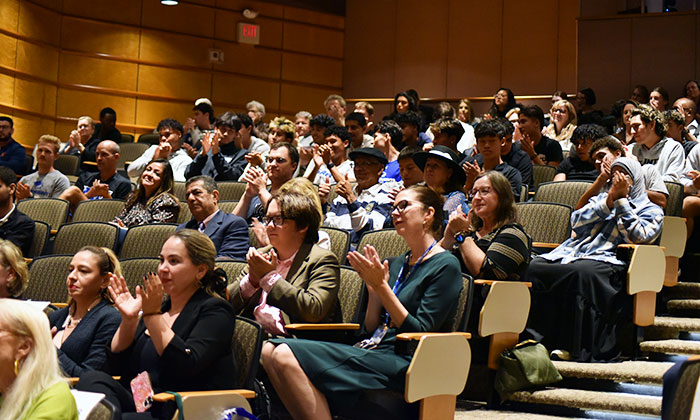
Fellow panelist Jesus Rios, a Health Sciences student and player on Marymount’s Men’s Soccer team, noted the impact of the Ambassador’s message about unity between North American countries.
“Growing up, I always felt that it was Mexico versus the U.S., and versus Canada,” Rios said. “So it felt nicer to hear that ultimately we would all benefit by working together and being in unison.”
For Valeria Medina Martinez, a senior Interior Architecture and Design student from Mexico, the experience was especially meaningful as she’s currently working on a capstone project that involves designing a residence for the Mexican Ambassador in Washington, D.C.
“Being a Mexican, hearing from such an important figure in my home country and listening to his perspectives was great,” she said. “I can’t wait to tell my family!”
As the visit coincided with Hispanic Heritage Month and Mexico’s recent Independence Day on September 16, the Ambassador’s presence at Marymount was particularly symbolic of the University’s commitment to celebrate diversity and foster global connections while preparing students for success in an increasingly interconnected world.
