




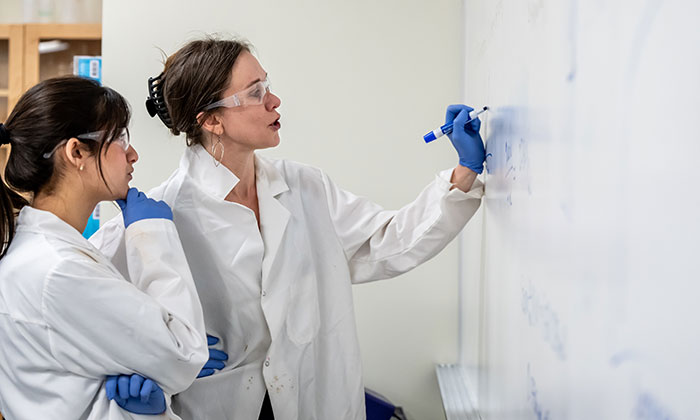
On April 15, Marymount students and faculty gathered at the Ballston Center for the annual Student Research Conference, showcasing undergraduate and graduate research spanning global health, sustainable technology and equitable education. The event highlighted the central role of research in the Marymount experience.
“Seeing the scope of research topics and methods applied by our students at every level is a true testament to the strength of Marymount’s curriculum,” said Joe Provenzano, Marymount’s Assistant Provost for Teaching and Assessment and Student Research Conference coordinator. “Our students are asking the right questions and exploring some of the most pressing topics of our time, thanks to our faculty members who have developed courses that are current and truly cutting edge.”
Accelerated Bachelor of Science in Nursing (ABSN) student Derrick Taylor spent his final year at Marymount investigating antimicrobial resistance in soil across varying elevations in Virginia. His project, conducted under the supervision of Dr. Alexandra Shah as part of the Tiny Earth initiative, examined how environmental factors such as elevation can influence microbial diversity and resistance.
Taylor said his interest in the topic stems from his work in global health at the U.S. Department of State.
“Antimicrobial resistance is one of the leading global health concerns that researchers around the world are trying to combat,” Taylor said. “This research gave me the opportunity to explore it from a very technical perspective.”
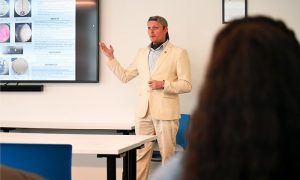
The idea for his study came while hiking the Appalachian Trail.
“I started thinking about how elevation impacts environmental factors like oxygen levels and climate,” he said. “That led me to ask whether elevation could also influence soil microbial diversity or antimicrobial properties.”
After collecting soil samples from sites ranging from near sea level to the summit of White Top Mountain, Taylor discovered antimicrobial-resistant bacteria even in familiar environments, such as the park near his house.
“One of my biggest takeaways is that antimicrobial resistance is everywhere, and there’s still so much we don’t know,” he said. “It highlights the need for continued research and suggests that potential solutions to global health challenges could be closer than we think.”
Doctoral student Justine Cameron spent the year examining the persistent underrepresentation of women in higher education leadership, an issue she encountered throughout her career in higher education.
“Across the country women make up the majority of undergraduate and graduate students yet there are very few women occupying leadership roles at higher education institutions,” Cameron explained. “When you add intersecting identities, such as race or ethnicity, the underrepresentation of women in leadership roles becomes even more pronounced.”
Her conference presentation represents an early component of her dissertation research in Marymount’s Educational Leadership and Organizational Innovation program. Her broader work, inspired by her own experience of becoming a mother, explores how motherhood shapes leadership identity, style and opportunity.
Cameron said one of her most notable findings so far is the presence of bias in hiring and advancement.
“Working mothers are often perceived as less competent or committed due to their family responsibilities,” she said. “In academic settings, expectations around tenure and research productivity often overlap with the years when many individuals start families, which can significantly impact career progression.”
Through her research, Cameron hopes to reframe those perceptions.
“I want to position motherhood as a ‘leadership crucible’, something that strengthens leadership capacity,” she said. “Ultimately, I hope to contribute to more equitable policies and shift the narrative, so motherhood is seen as an asset rather than a limitation.”
Sophomore cybersecurity major Anna Brisiuck explored the environmental impact of artificial intelligence in her first major research project, focusing on the resource demands of data centers.
“We were learning about AI in class, and I started looking into the environmental impact of data centers,” Brisiuck said. “I was shocked to learn that a single data center can consume as much electricity as about 75,000 homes.”
With a longstanding interest in both technology and environmental issues, Brisiuck used the project to explore how the two intersect. Her research revealed not only the scale of the problem, but also the lack of widespread mitigation efforts.
“It changed how I personally use AI,” she said. “Even something as simple as a search has an environmental impact, and many companies aren’t doing enough to address that.”
Presenting at the conference marked a major personal milestone.
“As a freshman, I never would have imagined presenting in front of a room full of people,” Brisiuck said. “Getting positive feedback and seeing people engage with my research really boosted my confidence.”
She hopes to continue developing the project and contribute to future solutions.
“I’d like to be part of creating change and helping reduce the environmental impact of these technologies,” she said.
Provenzano encouraged all Marymount students to engage in meaningful research during their studies to help “push the boundaries” of their fields and contribute to future advancements.
“Research gives students a voice in the ‘great conversation’ and we want to hear those voices,” Provenzano said. “The opportunity to present research and receive feedback is invaluable to our students and helps them become better researchers and conduct more impactful research.”
