




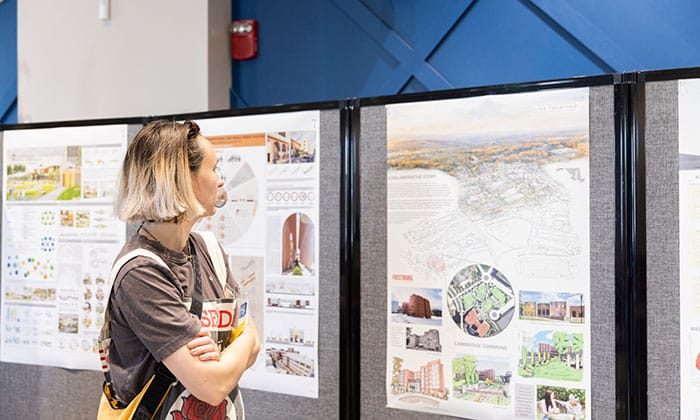
A collaborative team of designers, including individuals from Marymount’s School of Design and Art, has been named a first-place winner of the inaugural Penn State Intergenerational Community Design Competition for its project titled, “Cambridge Residences: Intergenerational Campus Community.” The team shares the first-place prize with the Penn State team.
The project is a real-world collaboration between Marymount’s Interior Architecture and Design program, Live Together — a nonprofit developer of intergenerational demonstration projects and workforce development initiatives — and JSR Associates, Inc., a Healthcare and Senior Living design firm.
Associate Professor Moira Denson, who also serves on Live Together’s Advisory Council, said that this project represents a “meaningful example of the applied mentorship, research and real-world collaboration possible in the field of design.”
Denson tapped Graduate Research Assistant Mallory Myers-Payne to assist with research, design and overall presentation of the project’s design elements, operational wellness model and intergenerational framework.
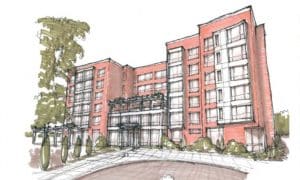
Together, the interdisciplinary team redesigned a vacant residence hall at Maryland’s Frostburg State University into the Cambridge Residences + Commons, which includes 40 cooperative living units. The space brings together older adults, families, graduates and students in a shared environment centered on connection, wellness, workforce development and engagement. The model also incorporates an experiential learning lab where Frostburg students in nursing, kinesiology, social work and psychology can directly engage with residents.
“Cambridge Residences was conceived as a response to overlapping challenges faced by both higher education institutions and aging communities such as social isolation, workforce development needs and underutilized campus infrastructure,” said Jane Rohde, Live Together’s founder. “Rather than addressing these issues in isolation, our project proposes an integrated, intergenerational design that positions housing as a platform for learning, connection and community well-being.”
Myers-Payne said projects like the Cambridge Residences are important given the projected shifts in national demographics that will occur over the next decade.
“The population is aging rapidly, and communities need spaces that support older adults while also connecting them to people of different generations,” Myers-Payne said. “Research consistently shows that children benefit from spending time with older adults, and older adults benefit from remaining connected to broader communities. There are social, emotional and educational advantages for everyone involved.”
Myers-Payne said the project felt like a “crash course” in professional design practice, helping her to expand her collaborative skills.
“Working alongside industry professionals has given me exposure to parts of the industry that students don’t always see. I’ve learned a lot about development, budgeting, grant funding and the realities of getting a project off the ground. This process has felt more like professional practice than a classroom assignment.”
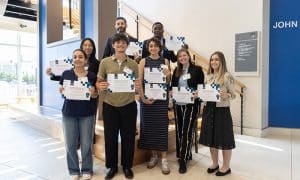
In June, Denson and Myers-Payne attended the Biennial Mid-Atlantic Intergenerational Conference at Stockton University in Atlantic City, New Jersey, where they accepted their first-place prize on behalf of Marymount, Live Together and JSR Associates. Their project generated significant interest among professionals in design, aging services and higher education.
“It was exciting to see the project recognized and to share it with the wider community,” Denson said. “This project intentionally breaks down silos by bringing together policy, design, workforce development, programming and community engagement in a way that doesn’t usually happen. It was meaningful to share an example of collaboration in an industry that can often be very competitive.”
Looking ahead, Denson hopes to continue to give students opportunities to contribute to meaningful projects with real-world impacts.
“What excites me most is that a Marymount student had the opportunity to work on a real-world project and collaborate with professionals from multiple disciplines to contribute to a nationally recognized design effort,” Denson said. “To me, this project is a wonderful example of experiential learning and collaboration. We are proud to have been part of the team and look forward to seeing where the project may go in the future.”
