




Disability Pride Month: Designing Spaces That Foster Dignity and Belonging

A Conversation with Jessica Bonness, Associate Professor of Interior Architecture and Design at Marymount University
How does your work in interior architecture and design intersect with disability awareness?
I teach human-centered design and design thinking, which is really about access and designing for all abilities. That encompasses disability and accessibility, but it’s also about a broader philosophy of doing the most for as many people as possible.
We should absolutely design for disability and accessibility by meeting codes, maximizing access and removing barriers. But simply meeting code doesn’t always take care of people. If someone has to go around the corner to use a ramp or the basement to use an elevator, then it is obvious that accessibility was an afterthought. That sort of “access” doesn’t contribute to belonging or inclusion, but denies people with disabilities the same dignified experience as everyone else.
When we engage in human-centered design, universal design, participatory design and co-design, we involve users throughout the design process. Rather than designing for people, assuming their needs and experiences, we’re designing with them to understand how they actually use a space. That approach goes beyond codes and looks at people as whole individuals.
How do you teach students to think about disability and accessibility?
One of the things I emphasize in my classes is the fact that there are varying kinds of differences in ability. There are permanent disabilities, temporary ones — like a broken arm — and situational ones, like trying to communicate in a loud concert where you can’t hear the person next to you. We need to be empathetic towards people who fall into each of these categories.
But rather than asking my students to pretend to have a disability — like using a blindfold or earmuffs to simulate blindness or deafness — I ask them to think about times they’ve sprained an ankle, pushed a stroller through a doorway or carried heavy groceries. Drawing on these personal experiences of situational and temporary disabilities, helps them build empathy and understanding in a more authentic way.
Why is design such an important part of creating more inclusive communities?
People often think interior design is just paint colors or furniture, but it’s largely about health, safety and welfare. It’s about things like wayfinding — helping people understand where they are and where they need to go.
Think about entering a hospital. Many people feel vulnerable, anxious or distracted. A confusing or inaccessible space can aggravate these feelings and make the experience overwhelming.
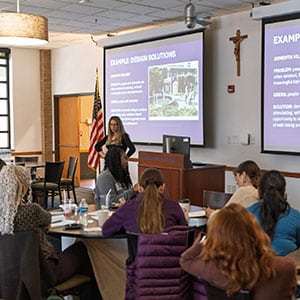
Good design provides signage, visual cues, landmarks and intuitive layouts that make the experience more efficient, more dignified and less frustrating. Designers are the people making decisions about door hardware, circulation, signage and countless other details. We also think about cognitive accessibility through simplicity, symbols, signage and communication that supports both individuals and their caregivers. All of those seemingly small choices add up and shape how people experience a space.
Part of designing for disability is knowing that people will all navigate the space differently. What might be intuitive to you may be more challenging for someone who is deaf or colorblind, for example. Our goal is to try and create spaces that are welcoming and easy to navigate for patients and caregivers of every ability.
You will be speaking at the SPARC Summit later this month on the topic of Advancing Dignity for Adults with Severe and Multiple Disabilities. What are you planning to share?
I am very excited to be a part of the panelists at the SPARC Summit. I think a lot of the audience will be medical professionals rather than designers, so I want to introduce ideas like universal design, participatory design and co-design in a simple, practical way. I want to encourage those professionals to get involved in design projects, because it is so important that we are designing spaces that not only look good but serve their needs.
I often tell the story of a hospital renovation that went wrong. When redesigning the open area, the nurses weren’t meaningfully consulted. The redesign was incredibly efficient, but it eliminated the shared nursing stations where staff naturally gathered to talk with one another about patients. In trying to maximize efficiency, they unintentionally reduced collaboration and potentially affected patient care. That’s why involving the people who actually use a space is so important. Hopefully I can encourage these professionals to make their voices heard and advocate for themselves during the design process.
What do you hope people learn about Marymount through your participation in the summit?
I hope they see that Marymount is a place where we’re intentionally preparing future designers, nurses and other professionals to think about accessibility, inclusion and human-centered design from the very beginning of their education.
That’s a big part of why we created our introductory Design Thinking course. It’s one thing to teach students how to be designers, but we also wanted to teach them how to think like designers — developing a philosophy centered on people before they ever enter the profession. I want people to understand that everyone can play a role in creating more inclusive environments, even if they aren’t designers themselves.
