




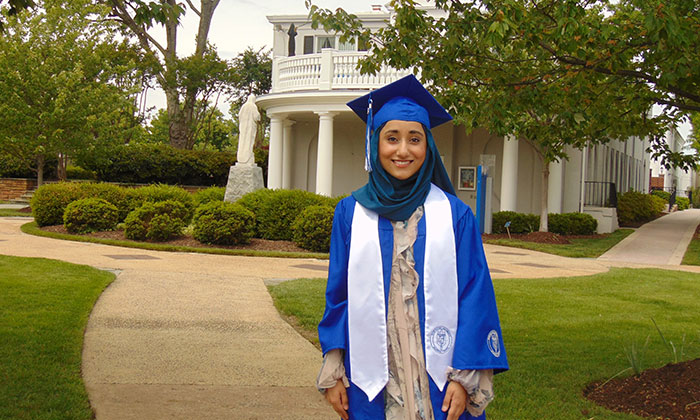
When Urooj Fatima walked across the stage at the 2025 College of Sciences and Humanities Commencement ceremony, she made history as Marymount’s first Biomedical Engineering graduate.
She began her Marymount journey in 2020, choosing to stay close to her family home in Virginia during the COVID-19 pandemic. Originally enrolled as a Biochemistry major, she switched to the brand-new Biomedical Engineering program in 2022 after taking classes on 3D printing prosthetic limbs.
“After learning more about what biomedical engineering is—applying engineering to the medical field—I knew I had found what I wanted to study. I always wanted to do something that involved research and had a real impact on people, so biomedical engineering felt like the right fit for me.”
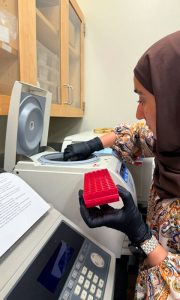
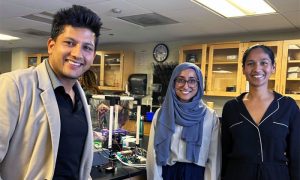
She dedicated the rest of her college years to undergraduate research, exploring the many applications of biomedical engineering. Under the direction of Dr. Shama Iyer, Fatima conducted research in bioinformatics, skeletal muscle regeneration, prototype development and molecular biology.
“Urooj is always prompt, well prepared, eager and motivated to learn,” Dr. Iyer said. “Her ability to work and lead engineers, biologists and researchers in widely different disciplines and excel in these projects is remarkable.”
“It was amazing to see the program grow and enroll more students over the years,” Fatima added. “Being the first person in the program, I had a lot of input on how it changed and developed. They asked for my feedback after each semester, and I helped in the hiring process of professors who taught specialized courses. It felt great to have a tangible impact, and it has been an honor to help pave the way for students who will enroll in this program in the future.”
Fatima’s dedication to biomedical research and service to others earned her one of the coveted Clare Boothe Luce Scholarships for Women in STEM.
“Urooj is a true student leader and always engages her peers with enthusiasm, warmth and an inclusive attitude,” Dr. Iyer said. “I have often observed her assisting other students in the classroom and the lab, helping them get a more in-depth and enjoyable learning experience. We are truly fortunate to have had Urooj in our program as she has set a high bar for future students as both a researcher and a mentor. She has demonstrated what it truly means to learn and lead with purpose.”
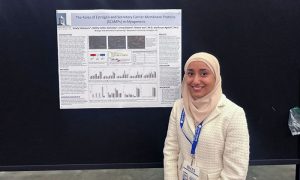
In the fall of her senior year, Fatima joined a team of Marymount students and professors in presenting research on the roles of estrogen and secretory carrier member proteins in myogenesis at the 2025 Biomedical Engineering Society Conference in Baltimore. There, she networked with professionals and learned about research avenues within the biomedical engineering industry.
“We met people from other universities at the conference and saw the research they were doing in the field, which was eye-opening for me,” Fatima recalled. “Many of the talks I attended focused on the applications of biomedical engineering in women’s health, which is something I find myself drawn to. I was already thinking of pursuing a Ph.D. at some point, and my experience at the conference reinforced that desire.”
Before graduating, Fatima passed her Fundamentals of Engineering (FE) exam, opening up a pathway to earn a professional engineering license. In the immediate future, she hopes to find a laboratory role where she can perform research in tissue engineering related to women’s health.
Reflecting on her Marymount experience, Fatima is grateful for the supportive campus community that gave her the confidence to explore her research interests.
“The thing that I love most about Marymount is the environment. My peers and professors have been so supportive throughout my entire college journey. I never felt like I was treated differently as a woman of color in STEM. Marymount has provided a safe place for me to explore my interests and grow as a person and as a researcher.”
