





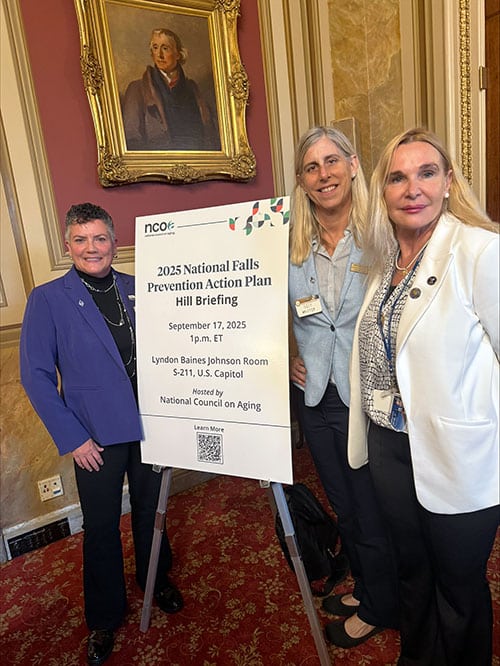
Dr. Sara Pappa, Associate Professor of Health and Human Performance at Marymount University, joined lawmakers and national leaders on Capitol Hill for the release of the 2025 National Falls Prevention Action Plan on September 17. The briefing, hosted by the National Council on Aging (NCOA), brought together experts and policymakers to highlight an urgent public health issue—older adult falls.
Falls are the leading cause of fatal and nonfatal injuries for Americans age 65 and older and send hundreds of thousands to emergency departments annually. Beyond the human toll, falls cost the health care system an estimated $80 billion each year, with Medicare and Medicaid covering more than two-thirds of those expenses.
The new Action Plan, released before Falls Prevention Awareness Week (September 22–26), lays out an integrated strategy to reduce deaths from falls by 18 percent and fall-related emergency room visits by 11 percent over the coming decade. It builds on earlier plans from 2005 and 2015, drawing on the latest research and a year-long collaborative process involving hundreds of experts across health care, public health, aging services, technology, housing, philanthropy and government.
“Falls are not an inevitable part of aging,” Dr. Pappa said. “We now have decades of research and proven strategies that can help older adults stay healthy, active and independent. By working together across health care, community organizations and government, we can dramatically reduce the toll that falls take on older Americans and their families.”
The 2025 Action Plan sets out six national goals to drive progress:
- Expanding public awareness with a sustained, multi-year communications campaign.
- Broadening and coordinating funding across sectors to strengthen prevention programs.
- Scaling evidence-based clinical and community interventions, especially in underserved communities.
- Driving stronger partnerships between clinical providers and community organizations.
- Generating new technologies and expanding access to existing tools for older adults.
- Improving data collection and research to better understand why older adults fall and how prevention efforts can be more effective.
The plan was guided by recommendations from the 2024 National Falls Prevention Summit, where more than 180 participants from 112 organizations worked together in cross-sector groups. Their collective vision emphasizes both immediate steps—such as awareness campaigns and data collection—and longer-term investments that could yield substantial returns for families, health systems and taxpayers.
As one of the speakers at the Capitol Hill briefing, Dr. Pappa emphasized the importance of scaling programs to meet the needs of diverse communities nationwide.
“Every older adult deserves the opportunity to live free from the fear of falling,” she explained. “That requires not only raising awareness but also ensuring that evidence-based programs and technologies reach those who need them most. The Action Plan is a roadmap to making that vision a reality.”
The NCOA’s goals align closely with the federal Healthy People 2030 objectives, which call for reducing fall-related deaths among older adults from 77 to 63 per 100,000 people and cutting emergency department visits from 6,052 to 5,447 per 100,000 people. Achieving these benchmarks, advocates say, will require coordinated effort across government, health care, technology and community organizations alike.
Dr. Pappa, along with many community partners, has been implementing evidence-based falls prevention programs throughout the DMV region since 2016. Through the Northern Virginia Falls Prevention Alliance, over 900 program leaders have been trained and over 10,000 older adults have been reached. This work, supported in part by the Administration on Community Living and Marymount’s Center for Optimal Aging, reflects the University’s commitment to addressing real-world health challenges on a national scale.
