




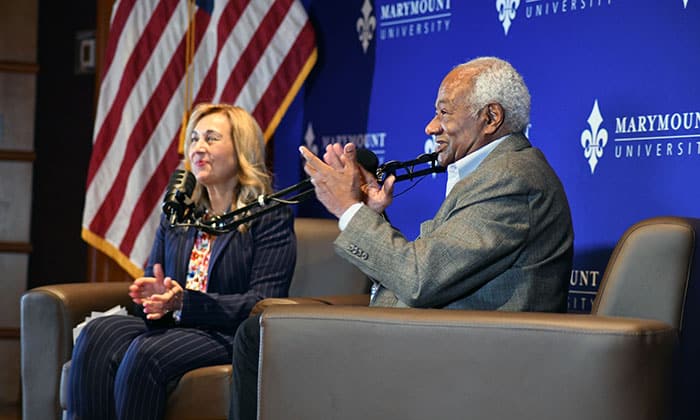
Marymount University’s Voices of Purpose podcast series continued with the live recording of its third episode on May 5 in the Reinsch Library, featuring a conversation between President Irma Becerra and longtime civic and business leader James W. Dyke Jr. The event brought students, faculty and the wider community together for a discussion on education, racial equity, civic engagement and the role of business leaders in advancing opportunity for all.
Guided by the enduring values of Winston Churchill—liberty and democracy, moral courage, global leadership, civic engagement and free enterprise—the Voices of Purpose series offers a platform for meaningful dialogue with leaders whose work has shaped public life and inspired social change. This episode explored how education and economic opportunity intersect to strengthen communities and democracy itself.
A graduate of Howard University and its School of Law, Dyke has held influential leadership positions throughout his career, including serving as Virginia’s first Black Secretary of Education and as domestic policy advisor to Vice President Walter Mondale, helping establish the federal Department of Education. He has also chaired the Greater Washington Board of Trade and the Northern Virginia Chamber of Commerce, and most recently served as an advisor to the Virginia Museum of History and Culture’s acclaimed Un/Bound: Free Black Virginians exhibition.
“Throughout his career, Jim has approached entrepreneurship and education as forces for social equality,” President Becerra said. “As the recipient of the Lifetime Achievement Award from the Virginia Chamber of Commerce, he has urged the business community to address inequality and promote reforms that will provide every Virginian with the opportunity to succeed and help grow our economy.”
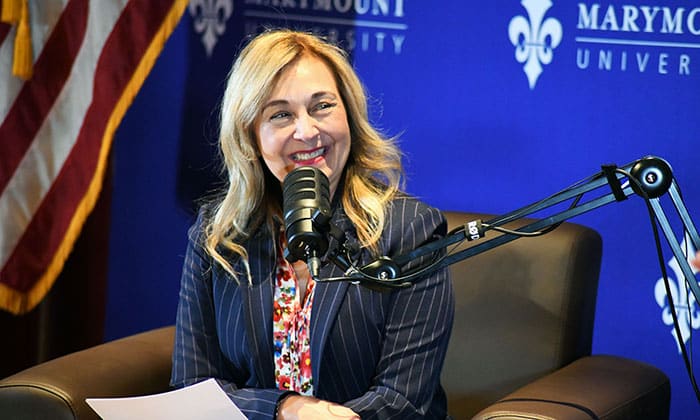
President Becerra guided a wide-ranging discussion on the responsibility of business and civic leaders to promote educational access and social mobility. Drawing on his own experiences growing up in segregated schools in Maryland and attending the March on Washington as a young man, Dyke reflected on how those formative moments inspired his lifelong commitment to education and public service.
“Unless you’ve walked in somebody else’s shoes, you don’t fully understand what they face. That’s why it’s so important to listen, learn and create opportunities for others,” Dyke explained. “The business community has an obligation to support education—not only because it’s the right thing to do, but because businesses succeed when everybody has an equal opportunity to contribute.”
The dialogue also focused on the transformative power of education and the importance of ensuring equal access for students from all backgrounds. Dyke emphasized that education remains one of the most effective tools for advancing equity and creating lasting opportunity.
“The beauty of an education is that once you’ve gotten it, it can’t be taken away from you. It’s then up to you to use it to the best of your ability to move forward,” he told the audience. “One of the worst crimes during slavery was teaching a slave to read, because people understood that once a person is educated and has skills, there’s no way you’re going to hold that person down. Education is fundamental, and equity is fundamental. If we truly believe in freedom and opportunity, then every person—regardless of race, gender, background, physical ability or country of origin—deserves the opportunity to develop to their full potential. Education is the way to do that.”
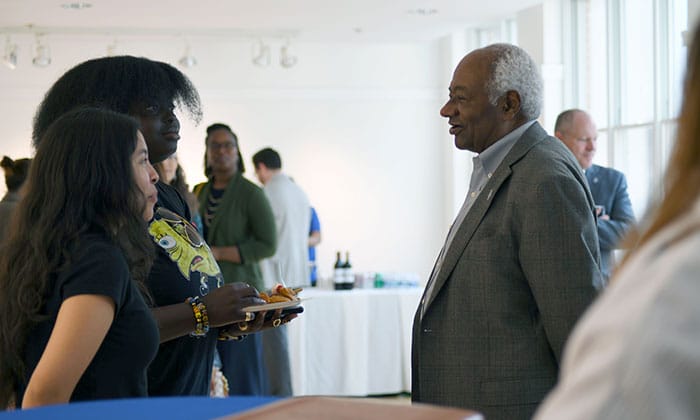
In addition to examining current challenges facing higher education, the conversation explored the importance of bipartisan collaboration and moral courage in a politically polarized era. President Becerra highlighted Dyke’s longstanding advocacy for educational equity and economic opportunity in Virginia and beyond.
“Your work has addressed racial injustice, the continued importance of higher education, the interconnectedness of individual success and overall prosperity and ways social change and economic growth can be mutually reinforcing,” President Becerra said. “We are grateful for your leadership in promoting prosperity, education and justice for all, which is one way of describing the American Dream.”
Dyke concluded the discussion by encouraging students and attendees to recognize the importance of mentorship in the service of future generations.
“I’m here standing on other people’s shoulders. And you need to make sure the people who come behind you are given not only the same opportunities you had, but even more.”
