





For many living with Parkinson’s disease, even simple tasks and activities can become monumental challenges. However, in a groundbreaking research study led by Marymount University and the nonprofit Up Ending Parkinson’s, patients challenge that narrative as they improve their mobility, balance and mental health at local rock climbing gyms and cliffs.
The research explores the effects of rock climbing on the physical and psychological well-being of patients with Parkinson’s, demonstrating that they’re capable of far more than might be expected. The study, “Defying Gravity: A Pilot Study of the Effects of Rock Climbing on Physical and Psychosocial Function of Individuals with Parkinson’s Disease,” seeks to uncover how the unlikely activity can serve as a therapeutic intervention for individuals managing the challenges of a neurodegenerative disorder.
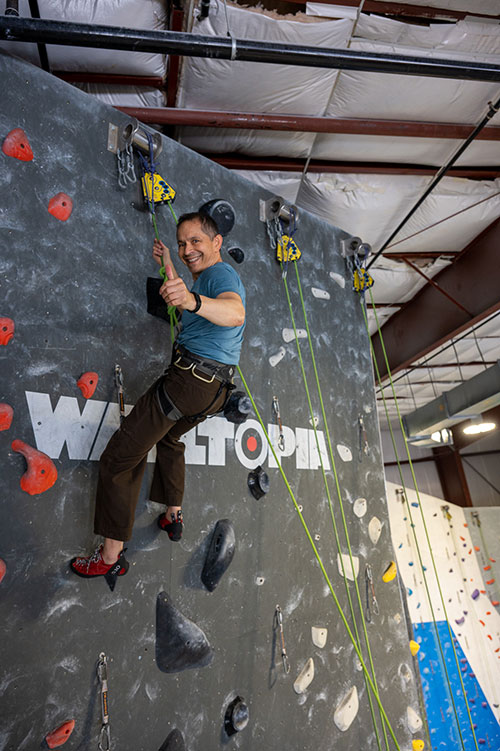
Throughout the study, which lasted from Summer 2023 to Summer 2024, participants showed significant improvement in balance, dexterity, grip strength and overall mobility, along with modest improvements in psychosocial aspects such as resilience and quality of life.
“In the world of neurological rehabilitation, ‘exercise is medicine.’ Climbing is unique, fun, challenging and community-oriented, so it would be exciting if it became a recognized option for people with Parkinson’s,” said Dr. Julie Ries, Marymount University’s lead researcher.
The study utilized a comprehensive approach to evaluate the effects of rock climbing on individuals with mild to moderate Parkinson’s symptoms. Participants engaged in 12 weeks of twice-weekly top-rope climbing sessions, each lasting 60 to 90 minutes. Sessions were tailored to each participant’s skill level, offering a progressive challenge to help them grow in strength, balance and mobility.
The intervention, according to Dr. Ries, was rooted in principles of exercise therapy known to benefit Parkinson’s patients, including aerobic and resistance training components, balance challenges and a community-based environment. While traditional Parkinson’s therapies often emphasize physical exercises to improve motor skills, rock climbing offers something uniquely beneficial – a dynamic combination of physical and cognitive challenges. Climbers follow specific routes on the wall, pushing their brains and bodies to adapt.
“In climbing, you follow an upward route designated by the color of the rock on the wall,” explained Molly Cupka, director of Sportrock Climbing Centers and founder of Up Ending Parkinson’s. “This inherently pushes people to think and work hard because you are encouraged not to simply grab any of the rocks on the wall within your reach.”
Using a rope while climbing also removes the fear of falling, something that often prevents patients from fully participating in other activities.
“Falling is one thing that limits patients from really pushing themselves in other activities, but in climbing they can push themselves as hard as they want,” Cupka added.
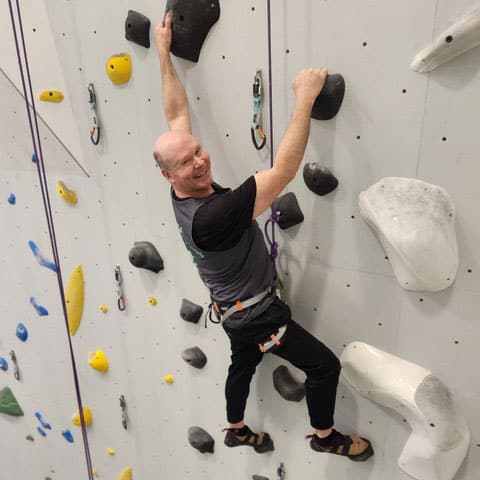
Study participants experienced not only physical improvements but also felt the support and camaraderie of a community of climbers.
“I recall trying to reach the top of a 60-foot wall at a level of difficulty I hadn’t mastered,” said participant John Rosiak, who was diagnosed with Parkinson’s one year ago. “I fell a few times, but the belayer – the person on the other end of the rope – caught me every time in a way so I didn’t lose any progress. Finally, I reached the top and my fellow climbers started cheering. Between the exhaustion from the climb and the feeling of gratitude for the support of my new friends, I cried with happiness as I was being lowered to the ground.”
“Climbing exercise has changed my life – walking out of the gym, I just feel better. I walk and move with greater confidence, my attitude towards life is positive and focused and I forget about Parkinson’s.”
The study’s preliminary results show that rock climbing can significantly enhance motor function in individuals with Parkinson’s and improve daily living, from walking to interacting with others.
“There is a lot of social reinforcement that all people with Parkinson’s are severely limited physically. But what was so obvious was the variability of Parkinson’s and its impacts on the individual,” explained Dr. Andrew Guccione, a colleague of Dr. Ries at George Mason University who helped design and carry out the research study. “We watched some patients, who had a fair amount of difficulty walking on a level surface, practically scurry up the wall. Only some parts of the brain are impacted by Parkinson’s, and the brain has a peculiar knack for devising workarounds using intact parts. This would explain why people who practiced climbing were also much better at walking after the 12 weeks we studied.”
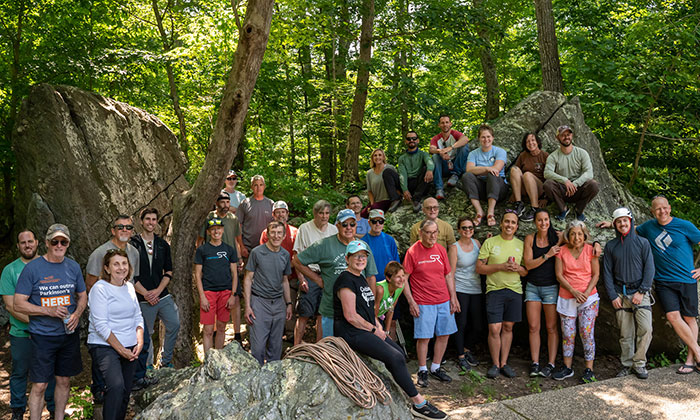
While the physical results are clear, the psychosocial benefits are still a subject of exploration. Researchers continue to evaluate how climbing impacts resilience, social adaptation and overall quality of life.
“I am hopeful that others see the benefits of climbing and that this research inspires funding for bigger studies to be done,” Cupka said. “Down the road, I would also love to see insurance covering activities like this, and research is a big step in making this happen.”
In addition to offering hope for individuals with Parkinson’s, the study also provided a unique opportunity for physical therapy students to immerse themselves in an innovative research area. Emily Heier, a third-year student in Marymount’s Doctor of Physical Therapy program who assisted in the study, said it was an eye-opening experience.
“Going into PT school, I thought I wanted to go into neuro rehab and down that path but I wasn’t 100 percent sold on it,” she said. “But after working on this study, it really solidified that this is the patient population I want to work with. Talking with everyone involved in the study and getting to know the participants was rewarding, and it makes me want to incorporate rock climbing into my PT practice because it slows the progression and improves symptoms.”
