




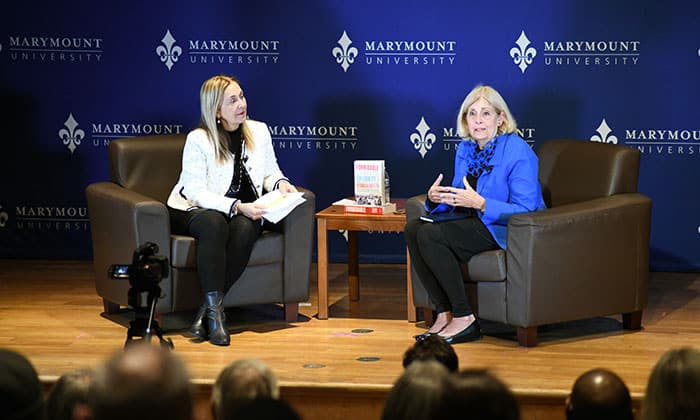
To celebrate the conclusion of Women’s History Month, Marymount University released the inaugural episode of its new presidential podcast, Voices of Purpose, exploring democratic values that shape ethical leadership.
Guided by the principles of Winston Churchill—liberty and democracy, moral courage, global leadership, civic engagement and free enterprise—the Voices of Purpose podcast fosters transformative conversations with leaders from business, government, education and beyond.
Recorded live on February 10 in the Reinsch Auditorium, the first episode featured a conversation between Marymount President Irma Becerra and distinguished historian and women’s rights advocate Dr. Elisabeth Griffith.
The evening opened with reflections on the core themes behind the series, including an introduction by Dr. Mattie Fitch, Assistant Professor of History in Marymount’s School of Humanities. Her scholarship examines antifascist cultures and democratic resilience in 20th-century Europe.
“Through my research, I’ve had the privilege of exploring how individuals and communities navigate moments of crisis, define their identities and imagine and defend their nations and values,” Dr. Fitch said. “These questions are as urgent today as they were in Churchill’s time, and I’m honored to facilitate this important dialogue on democracy and leadership.”
“As a Cuban immigrant, my family left Cuba looking for democracy, and now we see evidence of what happens in countries that have not protected democracy and freedom,” President Becerra added. “Churchill’s values are essential to a democratic society and are unfortunately very much at risk in many countries.”
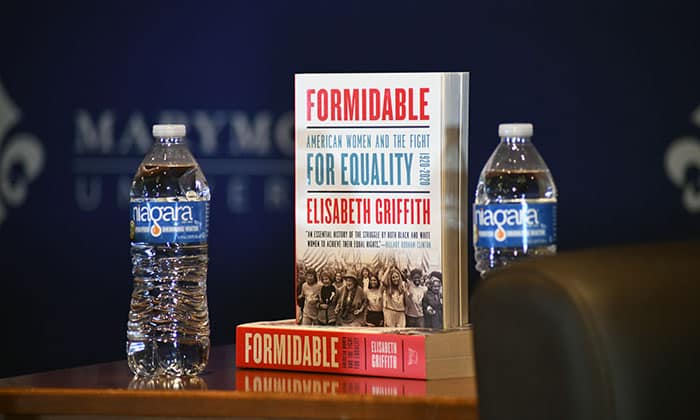
The conversation then turned to Dr. Griffith’s latest book, “Formidable: American Women and the Fight for Equality, 1920–2020,” which highlights the key figures and moments of the women’s suffrage movement and how women today continue to face challenges to equality. In her book, Dr. Griffith discusses the nuances of the suffrage movement, including its unconventional tactics and how it united women of all backgrounds and races.
“Suffrage succeeded because they were able to do something other groups couldn’t — build broad coalitions that ignored racial, cultural and socioeconomic barriers,” Dr. Griffith said. “The leaders didn’t always like each other or agree on everything, but they all had one goal—win the right to vote. Many women share a strong sense of community concern and community building, which can be a powerful unifying force. Democracy depends on connection and dialogue, and women have the unique ability to bridge that gap.”
Although women won the right to vote in 1920, Dr. Griffith emphasized that women still face inequality and sexism today.
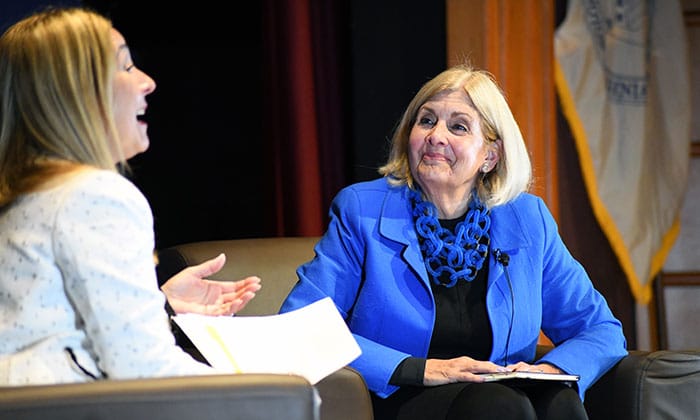
“If you plotted women’s progress from 1920 to 2020 on a line graph, it would not be a straight upward climb. We’ve made tremendous progress, but we are not there yet,” she explained. “Women have gained strength and tools over time, but progress is uneven.”
But she added that one of the most powerful tools in the modern woman’s arsenal is education, as it “equips women to participate meaningfully in democracy.”
“I am envious of students today in many ways,” Dr. Griffith said. “You are growing up in diverse communities where you can learn not only from your professors but from each other. Democracy depends on informed citizens, engagement, conversation and coalition building. You are already one step ahead simply by being in a community that encourages those experiences.”
Following the discussion, audience members were invited to ask questions, one of whom questioned how individuals can help promote democratic principles today.
“I feel so strongly about trying to find connections, about having a conversation with the person on the bus or being courteous to the person in line at the grocery store,” Dr. Griffith said. “Because democracy is not a one-person job. We need to do what the suffragettes did and build coalitions and communities that are willing to rally around preserving our democracy.”
Sophomore Hams Thamiri said the conversation gave her a new perspective on the importance of education.
“Dr. Griffith spoke powerfully about how education is not just about getting a degree, but about becoming an informed citizen who understands history and participates in society. This conversation helped me think more seriously about my role as a student and as a member of a democratic society.”
President Becerra emphasized how Marymount continues to create spaces where women can thrive, resulting in the University being named a top college for women by Newsweek and Gender Fair.
“Marymount was founded by women for women. Although we have expanded and diversified our student population, we remain dedicated to providing opportunities for women to grow, thrive and reach their full potential.”
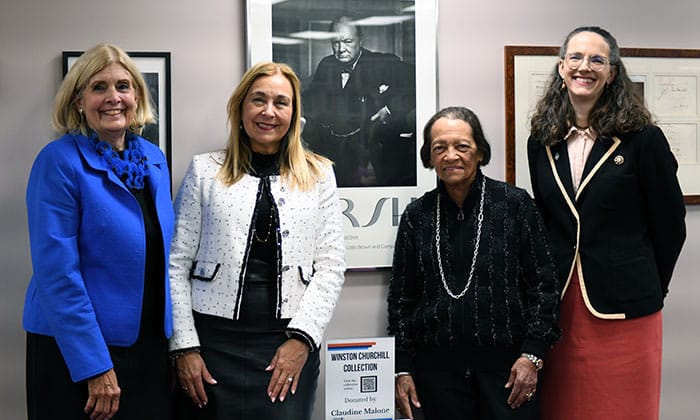
The evening also celebrated the generosity of Claudine B. Malone, CEO of Financial and Management Consulting Inc., who gifted her collection of Winston Churchill memorabilia to Marymount. Helping lay the groundwork for what would become the Voices of Purpose podcast, the collection is now on permanent display in the Reinsch Library.
President Becerra closed the night with remarks on her hopes for the podcast and the University’s future.
“I hope the conversations we foster through Voices of Purpose will empower our students to lead lives centered around Churchill’s enduring values of moral courage, leadership and civic engagement.”
