
Student Spotlight: Linda Alegria

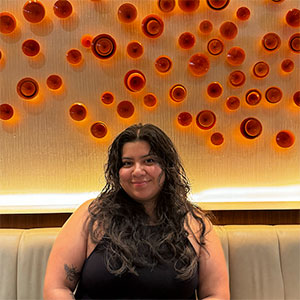
Class of 2025
Degree:
Interdisciplinary Studies (Education & Psychology)
Hometown:
Brooklyn, New York
Where are you from and what brought you to Marymount?
I grew up in Brooklyn, New York, in a very family-oriented Latina household. My mom is Mexican, and all seven of my aunts lived near us in Brooklyn, so I was always surrounded by family. I’ve been in the DMV for almost 10 years now. Initially, my dad and I came to D.C. on a short trip and stayed in Ballston, right near Marymount’s Ballston Center. We weren’t looking for colleges at the time, but my dad said, “Hey, there’s a university nearby. They might have open houses.” So we went, and I really enjoyed the visit. The guide was knowledgeable and made the campus feel homey, and the proximity to D.C. was appealing. I moved here in 2016 and I’ve been in the DMV ever since.
You’ve had a non-traditional educational journey. Can you tell me what that has been like?
My academic journey started in 2016, and I originally planned to graduate in 2020. I began as a psychology major with either an education or English minor because I’ve always been drawn to research, reading and writing. Even though I enjoyed what I was studying, I wasn’t very disciplined or focused. Then in 2019, my cousin passed away while I was working on a major research project. I dedicated the project to him, and my professors were incredibly supportive, but it was a hard time.
Then the COVID pandemic hit. Having family in New York made it even harder to be far away, and I wasn’t doing well academically or mentally. I decided to stop school, which was a difficult thing for my parents, especially since I was a first-generation student on my mom’s side. I left Marymount and worked at the neighboring Washington Golf and Country Club for seven years. I built really strong connections there, including with President Irma Becerra, who visited frequently. Dr. Becerra would always encourage me to return to school and eventually, she gave me her card and told me to make an appointment so we could figure things out. I wasn’t sure about returning to school; I felt that my time had passed. But my coworkers and supervisors really pushed me to take the leap and try it again. When I finally returned to Marymount, I realized how much I loved learning and how capable I really am. It was scary to start over, but I’m so glad I did. I am looking forward to all of the new opportunities that come with obtaining my degree and am grateful to all the people who have supported and encouraged me along the way.
What has been the biggest thing you’ve learned through this journey?
I learned that first and foremost, you have to be honest with yourself. For first-gen students there can be a lot of pressure to be successful and be a good role model for others. But being honest about where you are—mentally, emotionally, academically—takes so much weight off your shoulders and helps you move forward.
I also learned that taking time to figure things out is OK. Stepping away from school gave me the space I needed to grow, mature and figure out what I want to do. I realized that I want a career where I can use my research, writing and problem-solving skills to make a difference, not just to get a paycheck. Working on projects that tie academics to real-world issues has motivated me to keep studying. Last semester, I created a semester-long portfolio focused on housing insecurity and how education can support homeless students. Doing work that impacts my community made me believe even more strongly in finishing my degree so I can work to create positive change in the community.
Most of all I have learned just how strong my support system is. This experience has been a bit of a rollercoaster for my family. Initially, my parents were disappointed when I paused school, but once they understood how much I was struggling, they supported me. Now they’re incredibly proud and constantly checking in on me. Now, I can also feel the support from my younger brothers as they look ahead to their futures. Knowing they look up to me keeps me going. I can see how much my journey impacts them, and that makes me proud of myself too. I’m incredibly lucky to have such amazing family, friends, coworkers and mentors who have helped me to get to this point.
How would you describe your overall experience at Marymount?
I’ve had two very different and distinct experiences: Marymount then and Marymount now. When I first came, I lived on campus but didn’t get involved and that contributed a lot to feeling isolated. Now I’m much more connected. I talk to classmates, I keep up with events, and I am always excited for what is happening on campus. I’ve also loved the freedom to join and create clubs. My roommate and I started the Art Club in 2017–18, and now I’m taking printmaking with the professor who supported us back then.
Overall, I know I wouldn’t have had the same college experience anywhere else. The sense of community is real here. Because Marymount is small, I’ve been able to build strong relationships with my professors and access resources easily. Returning to campus, I’ve been able to take full advantage of those relationships and resources, and I feel more connected and supported than ever before.
What advice would you give to students, especially those on a non-traditional educational path?
Don’t be afraid to ask questions or seek advice. Even people who seem like they have it all figured out often don’t. Uncertainty is normal. Reach out to your support system. Get involved. Use your resources. And remember that it’s OK to have a non-traditional academic journey. What matters is that you keep going. At the end of the day, you’ll be the one who can say you achieved your goals in your own way.
