




Research Spotlight: Exploring Neurodiversity in the Criminal Justice System

Student Researcher:
Kaitlyn Pitt, Class of 2027
Project Title:
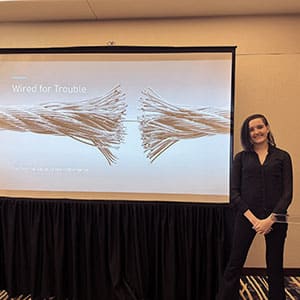
Wired for Trouble: The Criminalization of Neurodivergence
Degree Program:
Dual M.A. in Forensic & Legal Psychology and M.A. in Clinical Mental Health Counseling
Tell us about your background and what led you to Marymount.
I’m from the Chicagoland area, and I’ve lived here most of my life. I came to Marymount last year specifically for the Forensic & Legal Psychology program because there aren’t many forensic programs across the country, and Marymount offers one of the best. My background is rooted in psychology, criminology and the places where they intersect, so forensic psychology and counseling felt like natural paths for me.
Marymount’s program has been great. I’ve connected with so many professionals across different disciplines, even within psychology. Talking to people from different aspects and careers in the field has been my favorite part—building those connections and seeing all the ways we can make a difference.
Can you describe your research topic and why it interests you?
It was a fun departure from my usual research interests, which are typically diversion work and rehabilitation. For this one, I wanted to explore how neurodivergence relates to crime. Neurodivergence is an umbrella term for disorders or disabilities that affect cognition and neurological functioning—like autism spectrum disorder, ADHD, dyslexia, Tourette’s and many others.
My interests are personal. I’m neurodivergent, and my family includes many neurodivergent people. I’m always talking about crime and how to help others, so I wanted to ask, “what about people like me? How does being neurodivergent intersect with the criminal justice system in America?” This topic grew out of a paper for our Criminalization of the Mentally Ill class, and the mental illnesses that drew me in most were the ones that impacted me in my daily life.
What did the research process look like, and what were your biggest takeaways?
This was a solo project for a class, but I approached it as a meta-analysis—looking at what research exists, what it says and whether any patterns are emerging. I was pleasantly surprised to find that neurodivergence-related research in psychology and crime has spiked in the last two to three years. Usually research is scattered across decades, but much of what I found was recent, which shows how much society is beginning to pay attention.
I examined studies focusing on specific disorders—crime and autism, crime and ADHD, crime and dyslexia—and neurodivergence more broadly. One of the biggest shocks was just how little these groups actually commit crimes. I expected stigma to play a role, but the numbers showed that individuals with disorders like autism, when there are no co-morbidities, commit almost no crimes at all. The important distinction is between committing crimes and being criminalized. Neurodivergent people do encounter the criminal justice system, but the disorders alone are not predictive of criminal behavior, especially violent crime. And when offenses do occur, they’re overwhelmingly nonviolent.
Why is this topic important in the context of your two fields, Forensic & Legal Psychology and Clinical Mental Health Counseling?
People with neurodivergent disorders often need more social support—that’s simply the nature of having a disorder or disability. Counseling is one piece of that support system, and we need a stronger infrastructure in the U.S. to meet these needs.
When neurodivergent individuals get caught up in the criminal justice system, they’re often not getting the support they need. The system isn’t kind to anyone, but it’s especially traumatizing for people who struggle to communicate or advocate for themselves. On the forensic side, even though these groups aren’t committing significant crimes, they’re still being criminalized and there aren’t strong systems in place to protect their rights. Bridging these fields is essential.
What are your career goals post-graduation?
My broader career focus is on diversion work. For the last three years, I’ve run court-operated diversion programs, and I really enjoy working with people who have committed offenses and need support to break those patterns.
I currently help run a domestic violence offender program in Illinois called the Partner Abuse Intervention Program (PAIP). Clients are assigned to me by the court, and we do a 26-week program focused on skill-building and nonviolence. If they successfully complete the program, that fulfills their sentence. Programs like these are more effective and far less costly than incarceration. Long term, I want to design inclusive interventions like this—programs that work for everyone who goes through the criminal justice system, across all backgrounds, identities and mental health needs.
What advice would you give students about making the most of their college experience?
Get experience. Nothing prepared me for grad school like actually working in the field. I still remember my first day on the job at the PAIP program. I had spent years preparing, but I didn’t know if I’d actually like the work or be good at it. Then I did my first session with a client, and everything clicked. I knew I was meant to be there. Real-world experience gives you clarity and confidence. Even if the job is small or temporary, get out into the community and try things. The worst thing that happens is you realize it’s not for you, and then you know to try something else.
