




Alumni Spotlight: Sebastian Salinas
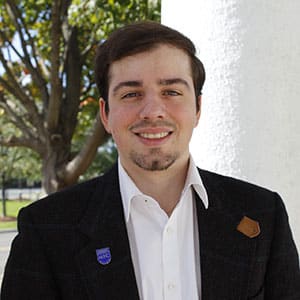
Class of 2025
Degree:
M.A. in Forensic and Legal Psychology
Hometown:
Annandale, Va.
Tell us about your background and what brought you to Marymount.
I’m half Cuban and half Peruvian. My dad immigrated from Peru when he was about 20 years old, making him a first-generation American. My mom was born here in the U.S., but her parents came from Cuba during the Communist revolution. So in my case, I’d say I’m a one-and-a-half generation American—rooted in both my family’s immigrant story and my own American upbringing.
I started my collegiate education at Northern Virginia Community College and earned my associate’s degree. Then I transferred to George Mason University, where I completed my bachelor’s degree in psychology. After undergrad, I took a break and moved to Baltimore to work at Johns Hopkins University as a research assistant. That opportunity came after I initially applied to doctoral programs and wasn’t accepted, largely because I didn’t yet have formal lab experience. I realized that was an area I needed to strengthen, so I worked at Hopkins to build my credentials. Later, when I reapplied, I was admitted to Marymount’s Forensic and Legal Psychology program. I moved back to Virginia to pursue it, and I’ve been really happy with that decision.
What was your overall experience like at Marymount?
I wasn’t sure what to expect at first. I only had a vague idea of what I might want to do after graduation, but the Forensic and Legal Psychology program turned out to be an excellent fit for my interests. I ended up specializing in Intelligence Studies, which allowed me to explore both the psychological aspects of law and crime, as well as the more applied, intelligence-driven side of security and analysis.
Outside of classes, I got heavily involved in extracurriculars. I joined the Marymount Intelligence Club and became very engaged, eventually serving on the executive board during my second year. I also worked as a graduate assistant through the Academic Hub, where I served as a writing tutor throughout my two years in the program. Tutoring was one of the most rewarding parts of my Marymount experience. I worked with a wide range of students—undergraduates, graduate students and even doctoral candidates—on everything from class papers to grad school essays, scholarship applications and job materials. That role allowed me to connect with so many people across campus, not just as a peer but also as a mentor. Helping others strengthen their writing and build confidence was fulfilling, and at the same time, I grew in my own leadership skills. It made me feel part of the broader Marymount community in a very meaningful way.
Overall, I found Marymount to be a place that challenged me academically while also giving me space to explore new interests and develop leadership skills.
How did Marymount’s campus community enhance your educational experience?
Diversity is incredibly valuable because it prepares us to thrive in a global society. For me, as someone of Hispanic heritage, it was meaningful to connect with other Hispanic students. We shared cultural similarities, and that gave me a sense of belonging.
Marymount also has a large population of international students, including many from Saudi Arabia and other parts of the Middle East. Working alongside them was eye-opening because I got to learn about their traditions, cultures and perspectives. Those interactions taught me the importance of understanding and appreciating differences while still finding common ground. It was an extremely enriching part of my education outside the classroom.
What has your career trajectory been like since graduation?
During my final semester at Marymount, I interned with the U.S. Marshals Service’s IT department at its Arlington headquarters. While there, I worked on service-related issues, liaising across divisions like prison operations, judicial security and staff management. I also helped with light cybersecurity tasks such as phishing prevention and ensuring system security. What I liked most was the chance to connect with people across the agency. While other interns were more siloed in specific divisions, I got to interact broadly and learn how different units contributed to the agency’s mission.
The internship gave me insight into how government agencies operate and taught me how to carry myself professionally in that environment. Even though I wasn’t in a psychology role, I learned how to navigate federal systems, interact with officials and handle sensitive processes.
A few days ago, I accepted an offer to be a consultant with the SEC. It’s not exactly aligned with my long-term vision, but it’s a strong opportunity and I’m grateful for it.
What advice would you give to college students about making the most of their experience?
Always say yes. If an opportunity comes your way—whether it’s an event, job fair, club or chance to present research—take it. Saying yes opens doors you don’t even know exist yet. It helps you grow personally and professionally while also preparing you for the next stage of your career.
