
Alumni Spotlight: Ameed Nsouli
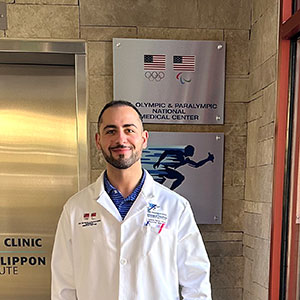
Class of 2016 & 2018
Degree:
B.A. in Psychology, Post-Baccalaureate Pre-Medical Sciences
Current Role:
Physician Associate in Orthopaedic Surgery (PA-C) at the Steadman Clinic and Steadman Philippon Research Institute (U.S. Olympic & Paralympic National Medical Center)
Hometown:
Bethesda, Md.
Where are you from and what brought you to Marymount?
I was raised in Bethesda, Md. Growing up in a family deeply rooted in medicine, I developed an early respect for disciplined study, clinical excellence and service. I also played football in college, an experience that shaped my work ethic and deepened my interest in musculoskeletal health and performance. Competing at that level required consistency, integrity and trust in a team, qualities that continue to influence how I practice medicine. Marymount offered a rigorous academic setting within a close-knit community. I was drawn to an institution that emphasized both intellectual development and professional formation. I was looking for an environment that would challenge me and prepare me for advanced medical training, and Marymount provided that foundation.
What was your overall Marymount experience like?
Academically, Marymount was demanding in the best way. The Psychology program strengthened my understanding of human behavior, communication and decision-making. These skills remain central to my practice in surgery today. The post-baccalaureate Pre-Medical Sciences program further refined my scientific foundation and prepared me for the intensity of medical training. Socially, Marymount fostered close mentorship with faculty. The relatively small class sizes allowed for meaningful relationships with professors who genuinely invested in student development. That mentorship model helped shape how I now approach teaching interns, students and trainees in my own clinical setting. From a career development standpoint, Marymount gave me clarity. It helped me confirm that I wanted to pursue medicine at a high level and compete for rigorous clinical medicine training opportunities.
What career development opportunities did you have while at Marymount?
The post-baccalaureate program was pivotal. It allowed me to demonstrate academic excellence in advanced science coursework and strengthened my competitiveness for clinical medical training. Graduating summa cum laude from both programs reflected the discipline and preparation that Marymount required. Being located in the Washington, D.C., area also provided access to early clinical exposure in neurology, immunology and neurosurgery. Those formative experiences reinforced my commitment to pursuing a career in medicine and contributed to my readiness for high-acuity rotations during physician associate training.
I remain deeply grateful to the faculty and mentors who shaped my pre-medical training, including Dr. Deana Jaber for her leadership of the program. My time at Marymount was foundational to my development as a clinician, and I am thankful for the rigorous science education I received.
What was your career trajectory after graduating?
Following Marymount, I pursued additional clinical experience in neurology, immunology and neurosurgery, contributed to peer-reviewed medical research and co-authored multiple publications in allergy, asthma and immunology. Participating in clinical medicine research strengthened my understanding of evidence appraisal and reinforced the importance of scientific rigor in clinical decision-making. Then, I earned my Master of Science in Physician Assistant Studies from Canisius University, graduating summa cum laude.
During my medical training, I sought out demanding clinical rotations, including emergency medicine, intensive care, general surgery, pediatrics, psychiatry, primary care, OB/GYN, internal medicine, hospital medicine, orthopaedic surgery and sports medicine. I was competitively selected for an elective orthopaedic surgery and sports medicine rotation with the University at Buffalo Medical Doctors (UBMD) Orthopaedics & Sports Medicine, where I participated in the care of professional athletes for the Buffalo Bills and Buffalo Sabres. After graduation, I joined the Steadman Clinic in Vail, Colo., where I now specialize in adult hip and knee reconstruction. Through the Clinic, I have gained valuable insight into orthopaedic care and treatment. The experience has been both professionally and personally rewarding. Practicing medicine in a world-class institute within a community that values outdoor activity has been fulfilling.
What do you do in your current role at the Steadman Clinic/U.S. Olympic & Paralympic National Medical Center?
I practice on an ultra-high volume adult joint reconstruction team. We perform over 1,000 complex hip and knee replacements annually. I evaluate new patients presenting with hip and knee pathology and guide them through both operative and non-operative treatment pathways. My responsibilities include comprehensive preoperative evaluations, intra-articular injections and surgical first assist in primary and revision joint arthroplasty, as well as structured postoperative follow-up care. My goal is to restore mobility and help patients remain active.
Working at the Steadman Clinic, which is a U.S. Olympic & Paralympic National Medical Center, reinforces the importance of trust, consistency, integrity, efficiency and quality. High-level performance, whether in sports or medicine, depends on preparation, teamwork and humility. As someone who used to play many sports growing up, I have great respect for athletes who make their health a priority and seek the care of the team at Steadman. I am truly grateful to be helping patients reach their physical and health goals in this respect.
What is unique about caring for athletes?
Elite athletes operate at the limits of human performance. Their recovery timelines, psychological resilience and return-to-play demands are distinct. Managing their care requires balancing long-term joint health with peak performance goals. It also demands close collaboration across multiple disciplines, including orthopaedics, physical therapy and sports psychology, creating a truly integrated model of care. That environment requires composure, preparation and meticulous, disciplined clinical judgment.
That said, my advice to any athlete about how to take better care of themselves—do not ignore sharp pain and do not push through it. Instead, consult a medical professional. Speaking with medical professionals to investigate your symptoms is crucial for longevity. And rest and recovery are just as important as practicing the sport.
What is your advice to students about how to make the most of their college experience?
Approach medicine with humility. The more you learn, the more you realize how much there is to understand. That mindset will keep you grounded and open to growth. Seek out opportunities to shadow broadly and early. Exposure to different specialties will clarify your interests and help you understand what the daily practice of medicine truly looks like. Finally, enjoy the experience. College is demanding, but it is also foundational.
